
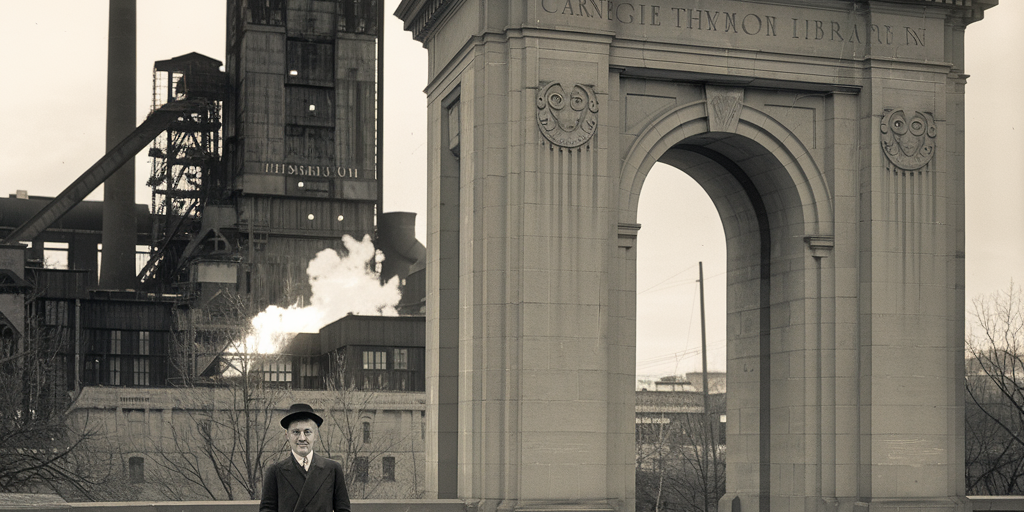
Introduction: From Dirt-Poor Immigrant to the Richest Man in America
Few figures loom larger in Pittsburgh’s history, or in American capitalism, than Andrew Carnegie. He arrived in Allegheny City at 12 with almost nothing, worked his way from a cotton mill to the Pennsylvania Railroad, and built the steel company that supplied the rails and beams of industrial America. In 1901 he sold it to J.P. Morgan’s syndicate for a price he reportedly named at $480 million and became, by most accounts, the richest man in the country.
This page covers the dates, the jobs, the deals and the people, and what he did with the money, from libraries to Carnegie Mellon to the Hero Fund, and the criticism it drew, is covered further down this page, in Andrew Carnegie’s legacy and philanthropy.
Andrew Carnegie at a Glance
- Born: November 25, 1835, Dunfermline, Scotland.
- Came to Pittsburgh: September 1848, to Allegheny City (today’s North Side).
- Career path: bobbin boy, telegraph messenger, telegraph operator, Pennsylvania Railroad secretary and division superintendent, investor, bridge builder, steelmaker.
- First steel plant: Edgar Thomson Works, Braddock, 1875.
- Bought Homestead Works: 1883.
- Carnegie Steel Company formed: 1892.
- Sold to J.P. Morgan: 1901 (U.S. Steel was formally incorporated in late February or early March 1901; sources give February 26 or March 2).
- Died: August 11, 1919, Lenox, Massachusetts, aged 83.
Dunfermline, 1835–1848: A Weaver’s Son
Carnegie was born in a weaver’s cottage in Dunfermline, Scotland, to William Carnegie and Margaret Morrison Carnegie. His father worked a handloom, and for a while the business did well. Then steam-powered looms arrived in Dunfermline in 1847 and put hundreds of hand-loom weavers out of work, William Carnegie among them, according to PBS’s American Experience timeline.
Margaret became the family’s main earner, selling potted meats from a small shop. Her brother, the Scottish political leader George Lauder Sr., introduced young Andrew to Robert Burns and the Scottish heroes, and Lauder’s son, also named George, grew up with Andrew and later became his business partner in Pittsburgh. The family borrowed money from the elder Lauder to emigrate. They sailed in 1848 and arrived in Allegheny in September of that year, where Margaret’s sisters already lived.
Allegheny City, 1848–1853: Bobbin Boy to Telegraph Operator
Carnegie’s first job was at Anchor Cotton Mills, a Scottish-owned factory. He changed spools of thread for $1.20 a week. He then moved to a bobbin factory run by another Scot, John Hay, for $2.00 a week. In 1849, on his uncle’s recommendation, he became a messenger boy at the Ohio Telegraph Company’s Pittsburgh office, at $2.50 a week, according to PBS.
The telegraph job changed his life. He memorized the streets and the faces of the men he delivered to, taught himself to read incoming signals by ear instead of from the paper tape, and was promoted to operator within about a year. On Saturday nights he borrowed books from Colonel James Anderson, a local man who opened his private library of roughly 400 volumes to working boys. Carnegie remembered it for the rest of his life; it is the root of the library philanthropy described in his legacy section below. You can read more about the neighborhood he grew up in at the rise and fall of Allegheny City.
The Railroad Years, 1853–1865
In 1853 Thomas A. Scott of the Pennsylvania Railroad hired Carnegie as his secretary and telegraph operator. Scott became his mentor and, as it turned out, his path to money. Carnegie learned railroad management and cost accounting from him. When Scott was promoted, Carnegie succeeded him, becoming superintendent of the railroad’s Western Division on December 1, 1859, at a salary of $1,500 a year. He was 24. (The city’s railroad story is told in the history of Pittsburgh’s railroads and Union Station.)
Scott also helped him make his first investments. In 1855, Carnegie put $500 into the Adams Express Company, financed by a $600 mortgage his mother took out on the family home. Later he bought into the Woodruff sleeping car company, an investment that PBS says began paying him more per year than his railroad salary. These were not purely open-market opportunities: Wikipedia notes that some of them arrived because of Carnegie’s relationship with Scott and J. Edgar Thomson, the Pennsylvania Railroad’s president, and describes some of the arrangements as insider trading. It is the kind of detail that older, admiring accounts leave out.
When the Civil War began in 1861, Scott became an assistant secretary of war, and Carnegie joined him to run military railways and telegraph lines in the East. He invested in oil (the Columbia Oil Company in Venango County in 1864 paid out more than $1 million in dividends in a year, according to Wikipedia). When he was drafted in 1864, he paid a substitute $850, as PBS reports, which was legal at the time.
In 1865 Carnegie left the railroad. By then his investments paid more than his salary did.
Iron and Bridges, 1865–1872
Carnegie and his associates reorganized a firm into the Keystone Bridge Company in 1865, with the aim of building bridges from iron rather than wood. He remained close to the Pennsylvania Railroad’s managers, Scott and Thomson, who were also Keystone’s best customers. Keystone supplied the metal for the landmark Eads Bridge across the Mississippi at St. Louis, completed in 1874, an early proof that steel could carry a major structure.
In 1868, at 33, Carnegie wrote himself a note. He planned to stop working at 35, live on about $50,000 a year, and spend the rest on benevolent causes. He did not stop at 35, but the idea came back in the essay that made him famous.
The Steel Years, 1872–1892
In 1872 Carnegie visited Henry Bessemer’s steelworks in England and saw the commercial promise of cheap steel. Back in Pittsburgh he began building the Edgar Thomson Works at Braddock, named for his old railroad patron. It made its first Bessemer steel in August 1875 and, according to PBS, its first order was for 2,000 steel rails for the Pennsylvania Railroad. The plant is still making steel today, which we cover in the rise and fall of Pittsburgh’s steel industry.
Carnegie’s method was to control every link in the chain. He pushed costs down, reinvested profits, and bought up suppliers. In 1881 he took an interest in Henry Clay Frick’s coke company and raised it to a majority. In 1883 he bought the Homestead Steel Works. By 1889 U.S. steel output had passed Britain’s, and Carnegie owned a large share of it. In 1892 he combined his holdings and those of his partners into the Carnegie Steel Company. For the technology and how the industry grew around him, see the technologies that built and broke Pittsburgh’s steel empire.
His company relied on friendly tariffs, which he lobbied to keep. Legal documents made public during the 1900 case with Frick showed how large that benefit was.
Carnegie’s Pittsburgh Sites in the Steel Years
- Edgar Thomson Works, Braddock: his first steel mill, opened in 1875, and still operating.
- Homestead Steel Works: bought in 1883 and the site of the 1892 lockout.
- Keystone Bridge Works and Union Iron Mills: the bridge and iron businesses that fed the steel business.
- Frick Coke Company: the fuel supply, controlled by Frick.
For the towns themselves, see Braddock, Homestead and the Mon Valley.
Family, Writing and “The Gospel of Wealth”
Carnegie married Louise Whitfield in 1887; their daughter Margaret was born in 1897. By then he was a prominent writer. Triumphant Democracy (1886) praised the American republic, and in 1889 he published the essay “Wealth,” which appeared in Britain as “The Gospel of Wealth.” Its argument is that a rich man’s life has two parts: earning, then giving. Carnegie Corporation of New York describes the rich, in his argument, as “trustees” of their money who should live unostentatiously, provide moderately for their families, and use the rest for the “general good,” such as universities, libraries, medical institutions and public parks. Two lines are usually quoted.
While the law of competition may be sometimes hard for the individual, it is best for the race.
The man who dies thus rich dies disgraced.
The first line, from the same essay, defends the competitive system that made him rich. The second is the one that made the essay famous. The full argument, and the criticism of it, are in the critics section below.
1892: Homestead
The Homestead lockout and battle of July 1892 are the largest stain on Carnegie’s reputation. He was in Scotland when the crisis came and left the details to his chairman, Henry Clay Frick. But he was not a bystander. In an April 4, 1892 letter, quoted by historian Philip Foner, Carnegie wrote that “these works, therefore, will be necessarily non-union after the expiration of the present agreement.” Carnegie had also written an essay in 1886 defending the right of workers to organize. The contradiction is the center of most arguments about him. For the full story, read our narrative of the Homestead Strike, or use the Homestead Strike quick facts. For Frick himself, see the life of Henry Clay Frick.
Frick and Carnegie were also members, with Andrew Mellon and others, of the South Fork Fishing and Hunting Club, whose dam failed in the Johnstown Flood of 1889. Carnegie later paid for a new library in Johnstown. See the Johnstown Flood of 1889.
1899–1901: Frick, Schwab and J.P. Morgan
By the late 1890s Carnegie’s partners were fighting. In 1899 the two disagreed over the price Carnegie Steel paid for Frick’s coke, and in December Frick was forced off the board. In early 1900 Carnegie tried to buy Frick’s shares at book value, and Frick sued; the case settled out of court that March. The relationship never recovered. Charles M. Schwab, a former Carnegie mill manager, had become president of the company in 1897.
Meanwhile Carnegie planned to expand into finished steel products, which threatened J.P. Morgan’s interests. Morgan wanted to merge the steel industry into one company. Schwab secretly negotiated the buyout. Carnegie signed the agreement letter on February 26, 1901, and the United States Steel Corporation was formally incorporated that winter (sources give February 26 or March 2, 1901; we have not found a source that settles which, though March 2 may be a closing date), capitalized at $1.4 billion, the first company worth more than $1 billion.
What did Carnegie get? Carnegie reportedly named a price of $480 million, and J.P. Morgan accepted. (The story of Carnegie scribbling the figure on a slip of paper is a popular one that ExplorePAHistory calls legend.) The owners were paid mostly in bonds and stock, about $492 million in all by one account, and Carnegie’s own share, about $226 million, was taken in 5% gold bonds. The $303.45 million figure that appears in some places is only the bond portion of the payment, not a rival price.
Carnegie, 65, retired from business. He had spent about three decades in iron and steel; now he spent his remaining 18 years giving the money away, on the schedule he had laid out in 1889.
Final Years and Death
Carnegie divided his time among a New York City house, Skibo Castle in Scotland (which he bought in 1897 or 1898 and rebuilt), and, after 1916, Shadowbrook, an estate in Lenox, Massachusetts. He left Scotland for the last time in 1914 when World War I began. He died of bronchial pneumonia at Shadowbrook on August 11, 1919, aged 83. By then he had given away roughly $350 million, according to the Carnegie Corporation; the rest of his estate, about $30 million, went to foundations and charities, and the New York Times estimated his total giving, counting bequests, at $371 million.
He is buried at Sleepy Hollow Cemetery in New York, not in Pittsburgh. His gravestone, a Celtic cross, is made from stone taken from Skibo, per PBS.
Key People in Carnegie’s Life
| Person | Role |
|---|---|
| Margaret Morrison Carnegie | His mother; supported the family in Dunfermline and drove the move to Allegheny. Carnegie Mellon’s Margaret Morrison Carnegie College is named for her. |
| William Carnegie | His father, a handloom weaver; died 1855. |
| George Lauder | Cousin and lifelong business partner (and his uncle, George Lauder Sr., helped the family emigrate). |
| Colonel James Anderson | Allegheny man who lent books to working boys, including Carnegie. |
| Thomas A. Scott | Pennsylvania Railroad executive; his mentor and the source of his first investments. |
| J. Edgar Thomson | President of the Pennsylvania Railroad; namesake of Carnegie’s first steel mill. |
| Henry Phipps | Longtime partner in the Carnegie firms. |
| Henry Clay Frick | Coke magnate; chairman of Carnegie Steel from 1889; ran the company during the Homestead lockout; broke with Carnegie in 1899–1900. |
| Charles M. Schwab | Mill manager who became Carnegie Steel’s president in 1897 and negotiated the 1901 sale. |
| J.P. Morgan | Financier who bought Carnegie Steel and formed U.S. Steel. |
| Louise Whitfield Carnegie | His wife from 1887. |
Timeline
- 1835: Born in Dunfermline, Scotland (November 25).
- 1848: Family emigrates; arrives in Allegheny in September. Works as a bobbin boy.
- 1849: Becomes a telegraph messenger.
- 1853: Joins the Pennsylvania Railroad as Thomas Scott’s secretary.
- 1859: Becomes superintendent of the Western Division (December 1).
- 1861–1865: Civil War service with the Union’s military railways and telegraph; leaves the railroad in 1865.
- 1865: Keystone Bridge Company organized.
- 1868: Writes his note to retire and give money away.
- 1872: Visits Bessemer’s plants in England.
- 1875: Edgar Thomson Works opens in Braddock.
- 1881–1883: Buys into Frick’s coke company, then buys the Homestead Works.
- 1887: Marries Louise Whitfield.
- 1889: Publishes “Wealth” (“The Gospel of Wealth”).
- 1892: Carnegie Steel Company formed; Homestead lockout and battle.
- 1899–1900: Break with Frick.
- 1901: Sale to J.P. Morgan; U.S. Steel incorporated (February 26 or March 2, depending on the source).
- 1919: Dies at Shadowbrook (August 11).
Where Carnegie Left His Mark on Pittsburgh
Carnegie’s name is on the Oakland cultural district (see how Oakland became Pittsburgh’s education and medical hub), on the Braddock library that became the first Carnegie library in the United States, and on a university, several museums and a hero fund. The specific dates, gifts and sites are laid out below. For the family names that built Pittsburgh alongside him, see the Mellon banking dynasty and the wider story in how the steel industry shaped Pittsburgh.
Carnegie’s Legacy: Libraries
Libraries were closest to Carnegie’s heart. As a boy in Allegheny he borrowed books from Colonel James Anderson’s private library, and he said that experience convinced him there was “no use to which money could be applied so productive of good” as a public library. Carnegie Corporation counts 2,509 libraries funded worldwide, including 1,681 in the United States, at a cost of about $56 million. Some popular sources give higher round numbers.
His usual terms were that he would pay for the building, and the town had to supply the land and promise a budget to run it. That condition spread library funding into local tax systems, and it also meant Carnegie decided which towns qualified.
- Braddock Carnegie Library: dedicated March 30, 1889, the first Carnegie library to open in the United States, built beside his Edgar Thomson steel works.
- Carnegie Free Library of Allegheny: Carnegie offered the money in 1886 and it opened on February 20, 1890, the first Carnegie library commissioned in the country. The building survives as the New Hazlett Theater.
- Carnegie Library of Pittsburgh, Main (Oakland): after an unaccepted $250,000 offer in 1881, Carnegie offered at least $1 million in 1890, once Pennsylvania authorized city library funding (according to the library’s history). Construction began in July 1893, and it was dedicated in the Music Hall on November 5, 1895.
- Carnegie Library of Homestead (Munhall): dedicated on November 5, 1898, six years after the lockout, it was both a gift and a source of resentment.
Carnegie Museums and Carnegie Mellon University
When Carnegie dedicated the Oakland library in November 1895, he announced a Department of Fine Arts and a natural history museum. That building, the Carnegie Institute, is the root of today’s Carnegie Museums; he called it his “monument,” according to the museums. The Carnegie International began in 1896, and the museum says it is the longest-running exhibition of international contemporary art in North America. Carnegie is often quoted as saying he wanted Pittsburgh to be “as famous for art as it is now for steel.” In 1899 a Carnegie-funded expedition found the skeleton that became Diplodocus carnegii, “Dippy,” at Sheep Creek, Wyoming. Paleontologist John Bell Hatcher named it in 1901. Carnegie broke ground on the museum’s major expansion in 1904, and the new building, with Dinosaur Hall, opened in 1907.
In 1900 Carnegie offered $1 million to start the Carnegie Technical Schools, aimed at working-class men and women who wanted practical skills, later raising his gift to about $2 million. The first students began classes in October 1905. The schools included the Margaret Morrison Carnegie School for Women, named for his mother. The institution became the degree-granting Carnegie Institute of Technology in 1912 and merged with the Mellon Institute in 1967 to become Carnegie Mellon University. Margaret Morrison Carnegie College closed in 1973 as women were fully integrated into the university. The Mellon family’s role is told in the Mellon banking dynasty.
The Carnegie Hero Fund
On January 25, 1904, an explosion at the Harwick Mine, north of Pittsburgh, killed 179 men. Two would-be rescuers, Selwyn M. Taylor of Pittsburgh and Daniel A. Lyle of Leechburg, died trying to reach survivors. Carnegie gave $40,000 to the relief effort and ordered two gold medals for the rescuers. On April 15, 1904, within three months of the disaster, he established the Carnegie Hero Fund Commission with about $5 million. It awards the Carnegie Medal to civilians who risk their lives to save others in the United States and Canada, and it is still based in Pittsburgh.
The Critics of Carnegie’s Giving
The first objection is where the money came from: the Homestead lockout described above. The second is that the gifts came with strings. In The Republic for Which It Stands (2017), historian Richard White argues that many Homestead steelworkers resented their library, in part because the work gave them little leisure and the company officers who controlled it chose what was on the shelves.
A third objection is that workers worked 12-hour shifts for low pay while the owner donated libraries. In 1901 Carnegie set aside $4 million for a relief and pension fund for Carnegie Steel workers, but the labor history remains contested. See the life of Henry Clay Frick for the managerial side.
His defenders point out that he argued for gifts, like free libraries, meant to help people educate themselves, and that he opposed the annexation of the Philippines and funded peace work. Whether that balances the labor record is a question this page leaves to you.
Frequently Asked Questions
When did Andrew Carnegie come to Pittsburgh?
Carnegie’s family arrived in Allegheny City in September 1848. He was 12. Allegheny City was a separate city until it was annexed to Pittsburgh in 1907 (voters approved consolidation in 1906, over Allegheny’s own majority) and is now the North Side.
Where did Andrew Carnegie live?
In Pittsburgh, Carnegie grew up in Allegheny City, today’s North Side, where his family arrived in September 1848 and his mother’s sisters already lived. In later life he divided his time among a New York City house, Skibo Castle in Scotland and Shadow Brook, an estate in Lenox, Massachusetts, which he bought in 1916 and where he died in 1919.
What did Andrew Carnegie build in Pittsburgh?
His first steel plant, the Edgar Thomson Works in Braddock (1875), and later the Homestead Works, which he bought in 1883. With his fortune he paid for libraries, including the first Carnegie library to open in the United States, in Braddock in 1889; the Carnegie Institute in Oakland, the root of today’s Carnegie Museums; the Carnegie Technical Schools, now Carnegie Mellon University; and the Carnegie Hero Fund Commission, still based in Pittsburgh.
How did Carnegie make his money?
First from investments he made as a Pennsylvania Railroad employee: sleeping cars, Adams Express and oil. Then from iron and bridges, and finally from steel, where he used the Bessemer process, vertical integration and low costs to dominate the market.
How much did Carnegie sell his steel company for?
Carnegie reportedly named a price of $480 million, and J.P. Morgan accepted. The owners were paid mostly in bonds and stock, about $492 million in all by one account; Carnegie’s own share, about $226 million, was taken in 5% gold bonds. The $303.45 million figure is only the bond portion.
Was Carnegie at Homestead during the strike?
No. He was in Scotland. Frick ran the company’s response, though Carnegie had approved the plan to break the union.
Where is Carnegie buried?
At Sleepy Hollow Cemetery in Sleepy Hollow, New York.
Where can I read more?
The PBS American Experience Carnegie timeline is a good short chronology, and Carnegie Corporation of New York has an overview of his life and giving.