
This is a legend piece. The sightings below are reports, told as their sources tell them, not established facts.
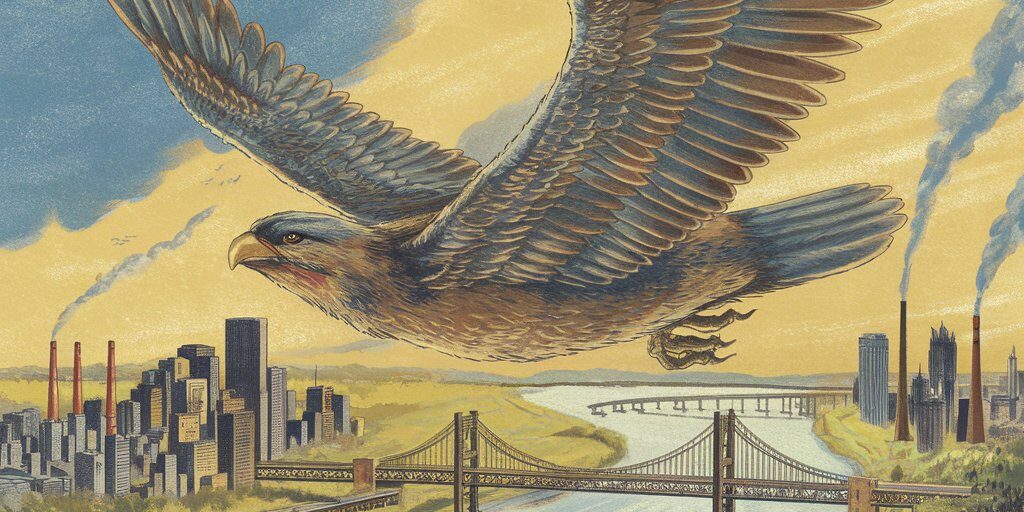
The Thunderbird legend has a Pittsburgh version, and it is the part of the story that is hardest to pin down. Pages around the internet, including an earlier version of this one, describe a giant bird seen in 1944 over Braddock, Clairton and Monongahela, with a 15- to 20-foot wingspan, a write-up in the Pittsburgh Press, and a quote from a Braddock man named James Runco. We looked for that story and could not trace it to any contemporary source. A search turns up no 1944 newspaper report and no Runco quote anywhere except this site and pages that repeat it. Until a 1944 clipping turns up, the Mon Valley sighting should be treated as an unconfirmed internet story. What can be documented is older and better: Native traditions of thunder beings, and a run of giant-bird reports from Pennsylvania’s northern forests that one writer collected and local newspapers printed.
Thunder beings in Native tradition
The thunderbird of modern cryptid lore borrows a name from Native traditions, and those traditions are not one story. The Pennsylvania Rambler, a regional history blog, notes that the sacred figure varies from culture to culture across the United States and Canada. Closer to Western Pennsylvania, the Lenape Talking Dictionary preserves a story told by the Lenape elder Nora Thompson Dean in 1977, “A Man Visited the Thunder Beings,” in which a man travels to where the thunder beings live, eats with them and returns home on a small cloud. In it an old thunder being tells him that people may sometimes hear them, and that the loud noise of the young thunder beings is heard when it is going to rain. The Smithsonian’s National Museum of the American Indian, in its guide for educators on the Haudenosaunee, describes a Thunder Festival held in April, “when the thunders that bring the rain are first heard.”
In these accounts, thunder beings are sacred figures tied to rain and weather. None of the sources we read connects them to a sighting of an animal over Pittsburgh, and we do not make that connection here.
The Black Forest reports
The documented Pennsylvania thunderbird is a creature of the north-central mountains, not the Mon Valley. Most of the old reports trace to one man, Robert R. Lyman Sr., a Potter County writer who collected local history and lore in his books Amazing Indeed. The Pennsylvania Rambler, which lists the reports, says most of the historical sightings can be traced to Lyman, and cites two newspaper pieces that drew on him: Curt Sutherly’s “Thunderbird: Myth or Fact?” in the Lebanon Daily News of February 17, 1975, and John Rasmussen’s “This ‘n’ That” column in the Lock Haven Express of January 29, 1971. We read the blog’s summary, not Lyman’s books or those papers themselves.
As the Rambler and the Pennsylvania Wilds tourism site, in an article by the Clinton County writer Lou Bernard, retell them, the reports include:
- Elvira Coates of Potter County, who said she had heard stories of the birds in the mid- to late 1800s. The Pennsylvania Wilds article says she heard them from local Native Americans.
- Fred Murray, who reported a flock near Dent’s Run, Cameron County, in 1892, looking like large vultures with sixteen-foot wingspans.
- A farmer near Centerville, Crawford County, who in 1898 was said to have captured a large bird he could not identify. The Rambler says it could find no mention of the capture outside Lyman, despite modern claims that it made national news.
- Lyman himself, who reported seeing a giant vulture-like bird on a road near Coudersport. The Rambler gives 1940 and a 25-foot wingspan; a review in northcentralpa.com says the early 1940s and at least 20 feet, measured against the width of the road.
- Hiram Cranmer, a retired postmaster in Leidy Township, Clinton County, who, according to the Pennsylvania Wilds article, said he saw his first thunderbird in 1922 and four others after that.
- A cluster of reports around Jersey Shore and Little Pine Creek from 1968 to 1971, including Judith Dingler, who on October 28, 1970, said she saw a bird the size of a small plane on Route 220.
Lyman’s own conclusion, quoted in a search excerpt of a page that appears to reproduce a cryptid encyclopedia entry, was that the birds were “with us today,” and that all reports for the previous 20 years had come from the southern edge of the Black Forest, between Pine Creek and Kettle Creek. The Rambler adds that newspaper reports slowed after Lyman died in 1974.
The lost photograph
Thunderbird lore has its own missing document. The Pennsylvania Wilds article describes a story that men once killed one of the birds, nailed it to a barn and posed for a photograph in front of it. The researcher Ivan Sanderson said he left the photo with Cranmer in 1963, the article says, and Cranmer died in a house fire in 1967, possibly taking it with him; Lyman wrote that the photo “burned in a home.” No one has produced it.
Lawndale, 1977, for context
One much-retold American giant-bird report comes from Illinois, not Pennsylvania. As retold from local coverage, on the evening of July 25, 1977, two large black birds swooped over a yard in Lawndale, Logan County, and one caught 10-year-old Marlon Lowe by his shirt and lifted him before dropping him as his mother screamed. A 2006 Lincoln Courier article, reproduced on a cryptozoology site, says the paper’s July 26, 1977, account gave the birds wingspans of 4 to 6 feet and said the boy was lifted about a foot. A 2014 Courier column, read only in excerpt, notes that accounts give the boy’s weight as 50, 56 or 65 pounds. Officials, according to one retelling, blamed turkey vultures. We read none of the 1977 coverage directly, so we give the case only as context.
What witnesses might be seeing
The largest land bird in North America is the California condor, which the U.S. Fish and Wildlife Service says has a wingspan of about 9.5 feet. It is not a bird of Pennsylvania. The turkey vulture, which is, has a wingspan of about 5.5 feet according to the National Park Service, or 5.7 to 6 feet according to the U.S. Department of Agriculture. Those are the real numbers that 15-, 20- and 25-foot estimates have to be measured against. Judging the size of a bird in the sky without a known distance is hard, as the northcentralpa.com review acknowledges, and none of the reports above comes with a specimen, a measurement or a surviving photograph.
Fact, legend and the disputed middle
| Claim | Status | Basis |
|---|---|---|
| Native peoples, including the Lenape and Haudenosaunee, have traditions of thunder beings tied to rain | Fact (about the traditions) | Lenape Talking Dictionary story; Smithsonian NMAI educator guide |
| A giant bird was seen over Braddock, Clairton and Monongahela in 1944 and reported in the Pittsburgh Press, with a quote from James Runco | Not traced | No contemporary source found; appears only online |
| 1930s Beaver County schoolchildren, 1952 Westmoreland County sighting, a “local historian, 1983” quote | Removed, no source | Could not be traced |
| Giant birds reported in Potter, Clinton, Cameron and Lycoming counties, 1890s to 1970s | Documented as reports | Lyman’s books and 1970s newspapers, as summarized by later writers |
| A photograph of a dead thunderbird nailed to a barn | Legend | No copy has ever been produced |
| Thunderbirds are a living species | No evidence | No specimen, measurement or photograph |
Why the Pittsburgh version matters anyway
The 1944 story says less about the sky over the Mon Valley than about how legends travel now. A detailed, quotable account with a name, three steel towns along the Monongahela and a newspaper credit can circulate for years without anyone producing the paper. If you have a 1944 Pittsburgh clipping about a giant bird, we would like to see it. Until then, the documented Pennsylvania thunderbird lives in the Black Forest. For more Western Pennsylvania legends told the same way, see our account of Charlie No-Face, and for the real history of the towns in the 1944 story, see the Steel Valley story.