
The Day Someone Blew Up a Payroll Convoy Near Pittsburgh
On a quiet South Hills road on the morning of March 11, 1927, the ground exploded.
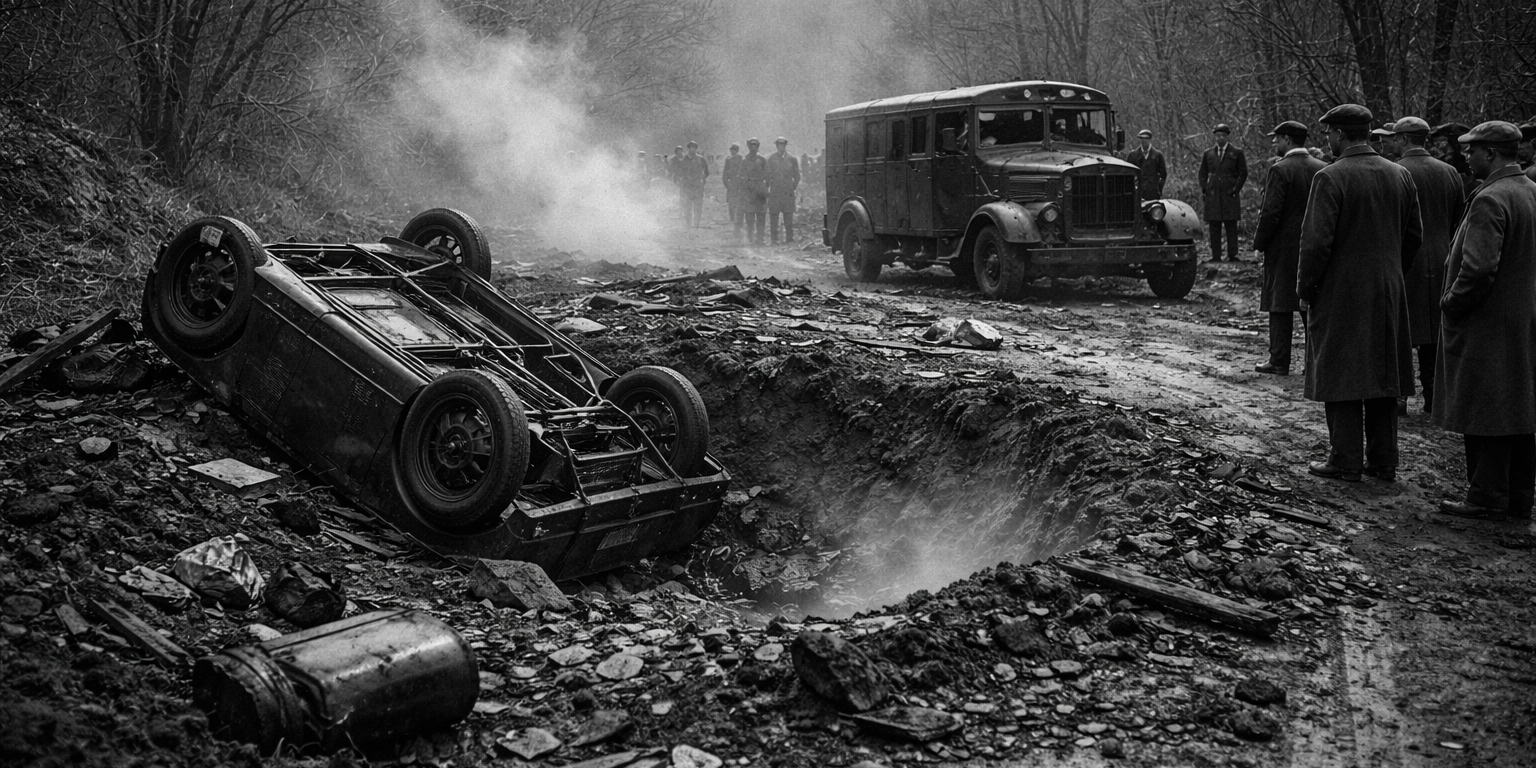
Not metaphorically. Not as a figure of speech. Someone had buried hundreds of pounds of black powder beneath the roadbed, waited for a Brink’s payroll convoy to roll over it, and then pulled the trigger. The blast ripped up the earth, disabled the vehicles, and left witnesses staring at a scene that looked like a war had arrived in Western Pennsylvania without sending any advance notice.
It was, by most accounts, the first armored car robbery in American history.
And it happened here.
Why Anyone Was Hauling $100,000 Down a Back Road in 1927
Before we get into the explosion, let’s talk about the world it happened in.
This was Pittsburgh in the late nineteen twenties. The mills were running. The mines were running. The railroads and terminals and industrial operations scattered across the surrounding region were all running, and every one of them had payroll. Big payroll. Because there was no direct deposit. No ACH transfer. No wire. On payday, actual cash had to physically travel from wherever it was counted to wherever workers were waiting to get paid.
That created a business. Brink’s existed to move that money. And a lot of criminals existed to take it.
Throw in Prohibition on top of all of that — the professional criminal class of this era was better organized, better financed, and more willing to be creative than almost any generation before it — and you have a recipe for what was about to happen on that road.
The Target
The convoy on March 11 was transporting payroll for the Pittsburgh Terminal Coal Company and its operations around Coverdale. Different retellings vary slightly on the specifics, but the core is consistent: an armored payroll vehicle with an escort, carrying what multiple accounts put at over $100,000.
In 1927 dollars, that’s a fortune.
The gang that had been watching the route understood that.
Meet the Flathead Gang
The crew responsible went by the name the Flathead Gang, led by a criminal named Paul Jaworski. The name sounds like it belongs on a pulpy paperback cover, but the operation they ran was not pulpy. It was methodical.
Jaworski was, by the accounts that exist, a serious operator. His gang didn’t rob things by accident. They studied logistics, identified vulnerabilities, and planned accordingly. And at some point, somebody in that crew had a very specific idea.
You don’t need to go through the armored car.
You just need to go through the road.
500 Pounds
Here’s the part where you need to stop and sit with a number.
According to accounts of the robbery, the gang buried approximately 500 pounds of black powder beneath the roadbed at the point they’d chosen for the ambush.
Not a stick of dynamite. Not a small charge. Five hundred pounds. The kind of quantity that requires planning, equipment, access, and a willingness to commit fully to the chaos that follows.
In Western Pennsylvania in 1927, access to explosives wasn’t impossible for someone determined to get them — the region ran on industrial blasting. The mines used it. The construction crews used it. The Flathead Gang simply redirected a regional skill toward a very different purpose.
When the convoy reached the kill zone, they detonated it.
What It Looked Like
Picture being in one of those vehicles.
You’re on a road you’ve probably driven before. The morning is ordinary. You’re thinking about nothing in particular.
Then the ground underneath you ceases to exist.
Accounts describe the explosion ripping up the roadway with enough force to overturn vehicles and disable the convoy on the spot. Photographs from later retellings show wrecked metal, cratered ground, and a crowd of neighborhood onlookers standing closer than any modern safety instinct would allow — because an explosion in your neighborhood draws people toward it before they think better of it.
Once the convoy was stopped, the gang moved in and took the money.
The whole concept of an armored car — a vehicle designed to withstand force — had been beaten not by a smarter lock or a bigger gun, but by the simple logic of ambush. You don’t fight the armor. You fight the route.
Why This Story Left Pittsburgh
Most local crimes stay local. This one didn’t.
The reason it kept getting retold, and the reason it still shows up in histories of organized crime and law enforcement, is that it was a blueprint. It demonstrated that a payroll convoy could be neutralized by disabling the road rather than the vehicle. It proved that criminals willing to think like engineers could leapfrog the security measures designed to stop criminals who thought like, well, criminals.
Once that lesson existed, everyone in the armored transport business had to acknowledge it.
Routes became vulnerabilities. Roads became potential kill zones. The whole framework of moving money had to evolve, because a crew in Western Pennsylvania had just shown what was possible when desperation and industrial knowledge met in the same plan.
What Happened to Paul Jaworski
The Flathead Gang didn’t ride into the sunset.
Jaworski’s criminal career caught up with him in the way these careers usually end. His gang was connected to multiple robberies and violent episodes beyond the Brink’s heist, including a payroll robbery that resulted in a murder. That murder charge is what ultimately put him on death row.
He was executed by the state of Pennsylvania.
It’s a common ending to an uncommon story. The big score, the bold plan, the years of escalation — and then the machinery of the law, moving slower but eventually catching up.
The Pittsburgh Angle
Some readers will note, accurately, that the robbery happened outside the city limits. The South Hills, the Coverdale area, the road where this all went down — these aren’t downtown Pittsburgh.
But Pittsburgh’s history has never been contained by city limits. Its story is the story of its whole industrial perimeter: the mines, the mills, the river routes, the payroll roads, the places where money moved through working landscapes that weren’t built with security in mind.
Where industrial money concentrated in this region, industrial crime followed. That’s been true since before the Carnegie era and it was true in 1927. A coal company payroll running down a South Hills road was as Pittsburgh a target as you could find.
If you want more context on how organized crime operated across the broader Pittsburgh area during this era, the history goes deep: Pittsburgh Mafia History
A Final Thought
March 11, 1927, is one of those dates that deserves to sit in the regional memory alongside the bigger, more famous moments.
Pittsburgh history is full of grit. Labor battles, industrial disasters, neighborhood stories that never made the national papers. This one did — because a criminal crew proved you could turn an ordinary road into a weapon, steal a fortune in broad daylight, and change how the whole country thought about moving money.
The crater filled in. The road got repaired. The crowds went home.
But the method stayed.