

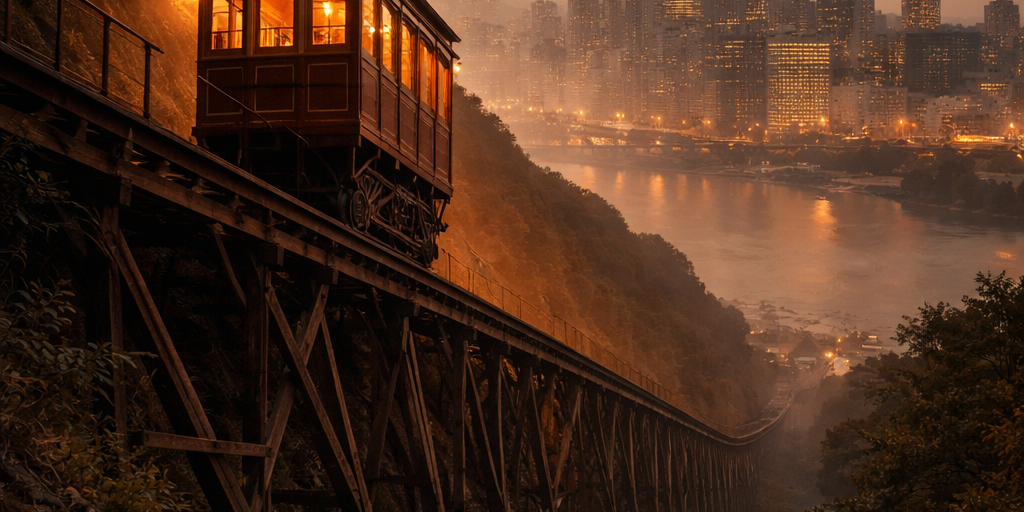
On a clear evening, if you stand at the base of the Duquesne Incline on West Carson Street and watch one of its vintage wooden cars creak slowly up the face of Mount Washington, it is easy to forget that you are looking at a piece of living Pittsburgh inclines history. The car climbs at a steep angle, cables taut, gears turning with the same unhurried confidence they have maintained since 1877. At the top, a deck overlooking the Golden Triangle offers what many consider the finest skyline view in America. But the incline was not built for tourists or for the view. It was built for steelworkers, factory hands, and the thousands of ordinary Pittsburghers who needed a practical, affordable way to get up and down a very steep hill every single day.
Pittsburgh is one of the hilliest cities in the country, a place where geology never cooperated with the grid. The terrain that made the city so difficult to navigate on foot was the same terrain that delivered its industrial greatness: the coal-rich hillsides feeding the furnaces below, the rivers converging to move raw materials and finished goods across the continent. The people who worked those furnaces and mills lived wherever they could afford, and for many of them, that meant the slopes. Getting to and from work was not a minor inconvenience. It was a genuine physical challenge, every single day, in every kind of weather.
The incline solved that problem in the most direct way imaginable. You got on, it pulled you up, and you went to work.
Coal Hill and the Problem of Getting There
Before it was called Mount Washington, the great bluff overlooking the south bank of the Monongahela River was known simply as Coal Hill. The name was accurate and unromantic. The hillside was threaded with coal seams that had been worked since the earliest days of European settlement, and the coal dug out of those slopes fed the forges and hearths of a growing town below. Workers living on the hill or in the neighborhoods behind it had to find their own way down each morning and back up each evening, on foot, along muddy paths that in winter could become genuinely dangerous.
By the mid-nineteenth century, Pittsburgh was exploding. The rise of the steel industry was drawing workers from across Pennsylvania, from Ireland, from Germany, from central and eastern Europe. The population of the hillside neighborhoods swelled. The need for reliable, affordable vertical transportation was not a luxury. It was a civic necessity.
The technology was already well established in Europe. Funicular railways, which operate on the counterbalance principle where one car descends as another rises, sharing a cable and trading weight to reduce the energy required, had been running in the Alps and in various British industrial cities for decades. Pittsburgh’s engineers looked at the hillside, looked at the European models, and decided the solution was obvious.
The Monongahela Incline: 1870
The Monongahela Incline opened on May 28, 1870, making it the oldest continuously operating funicular railway in the United States, a record it still holds today. The engineer was John Endres, and the project was backed by the Monongahela Incline Plane Company. The lower station sat on Carson Street; the upper station opened onto what would eventually become Grandview Avenue, with its commanding view of the city below.
The incline was immediately useful in ways that went beyond passenger transport. In its early years it carried freight as well, hauling goods and materials up and down the hill as the neighborhood above grew and spread. The wooden cable cars were built to handle serious loads and serious daily use, not the occasional tourist excursion.
What is remarkable about the Monongahela Incline is how little it has fundamentally changed in the century and a half since it opened. The route is the same. The counterbalance principle is the same. The upper station still commands the same view. The technology was right from the beginning, and there was no compelling reason to reinvent it.
Today the Monongahela Incline is operated by Pittsburgh Regional Transit and carries roughly half a million riders per year, a mix of Mount Washington residents using it as genuine daily transportation and visitors who have made the trip up to the observation deck a standard stop on any Pittsburgh itinerary.
The Duquesne Incline: 1877 and the Art of the Original
Seven years after the Monongahela Incline opened, a second funicular began running just a short distance to the west along the same bluff. The Duquesne Incline opened on May 20, 1877, designed by engineer Samuel Diescher, who would go on to design several more of Pittsburgh’s inclines during the boom years that followed. The Duquesne Incline Plane Company built and operated it, and from the beginning the Duquesne was a slightly different animal than its neighbor.
Where the Monongahela Incline was built with workmanlike practicality, the Duquesne had an air of refinement that reflected the neighborhood it served. The wooden cable cars built for the Duquesne were finished with more care and detail than was strictly necessary for hauling steelworkers. The upper station on Grandview Avenue was a proper Victorian building with exposed wood beams and period hardware that looked like someone had put genuine thought into aesthetics, not just function.
Those original 1877 cars are still running today. That sentence deserves a moment of appreciation. The cable cars currently in service on the Duquesne Incline are the same cars, restored and carefully maintained, that first climbed the face of Mount Washington when Ulysses S. Grant was in the White House. There are very few artifacts of working Pittsburgh history that you can actually ride.
The upper station of the Duquesne Incline houses a small museum with original operating machinery on display, including the cable drums and drive mechanisms that have been pulling those cars up the hill for nearly a century and a half. The machinery room is open to visitors and is the kind of place where mechanical history becomes tangible in a way that a photograph never quite achieves.
The Golden Age: Pittsburgh’s Full Fleet of Inclines
For a period spanning roughly the 1870s through the first decades of the twentieth century, Pittsburgh was the incline capital of the world. At the peak, the city had somewhere in the neighborhood of seventeen funicular railways connecting its river valleys to its hillside neighborhoods. Names like the Fort Pitt Incline, the Castle Shannon Incline, the Knoxville Incline, the Mt. Oliver Incline, and the St. Clair Incline were part of the daily geography of the city. Each one served a specific neighborhood, a specific community of workers who depended on it to maintain any reasonable quality of daily life.
The inclines were not novelties. They were infrastructure, as essential to their neighborhoods as the streetcar lines that ran along the valley floors below. The communities they served were dense, working class, and highly organized around the rhythms of industrial shift work. When the incline was running, the neighborhood functioned. When it was out of service, people were late for work or stranded on a hillside.
Samuel Diescher became the preeminent incline engineer in the region, designing multiple lines across the South Side slopes and beyond. His work was practical engineering in service of a specific urban problem, and he was very good at it. The consistency of the technology across different lines reflected his influence: counterbalance cable cars on steep grades, lower stations near the river, upper stations opening onto hilltop avenues.
The social dimension of the inclines is easy to overlook in retrospect but was central to their purpose. These were not transportation options for people who could afford alternatives. They were the transportation for the people who built and operated the mills, the factories, and the railroads that made Pittsburgh the industrial capital of the continent. The inclines were working class infrastructure, and the neighborhoods they connected were working class communities.
The Long Decline
The automobile changed everything, as it changed everything in American cities during the middle decades of the twentieth century. As car ownership spread and as new roads were cut through Pittsburgh’s hillsides to allow vehicle access to previously isolated neighborhoods, the inclines began to seem redundant. Ridership fell. Operating costs, which had always been fixed and significant, became harder to justify against diminishing revenue. One by one, the inclines closed.
The Fort Pitt Incline closed in 1953. The Castle Shannon Incline, one of the longest in the city, closed in 1965 after more than seven decades of service. The Knoxville Incline, the Mt. Oliver Incline, and the others went quiet in their own time, their lower stations eventually demolished or converted, their hillside paths overgrown. By the mid-1960s, only the Monongahela and the Duquesne remained, and neither was doing particularly well.
The Monongahela Incline had the advantage of continued municipal support, which kept it running even as ridership declined. The Duquesne Incline had no such backstop. The Duquesne Incline Plane Company announced that it would cease operations, and for a moment it appeared that the last Victorian cable car in Pittsburgh was going to be quietly retired and forgotten.
The Neighbors Who Refused to Let It Die
What happened next is one of the better stories in Pittsburgh preservation history, and it does not get nearly enough attention. A group of residents living in the Duquesne Heights neighborhood on the hillside above the incline decided that closing it was not acceptable, and they organized to stop it. In 1963 they formed the Society for the Preservation of the Duquesne Heights Incline, took over operation of the line, and kept it running through a combination of community fundraising, volunteer labor, and the kind of stubborn civic determination that Pittsburgh has demonstrated repeatedly when something it values is threatened.
The society is still the operating entity today. The Duquesne Incline is not a government-operated transit line. It is a community-operated historic landmark, sustained by the people who live near it and by the visitors who come to ride it. Ticket revenue, donations, and a small gift shop in the upper station keep the lights on and the cables moving.
This is a meaningful distinction. The Duquesne Incline survived not because a government agency protected it or because a wealthy benefactor stepped in to fund a restoration, but because the people who lived on the hill looked at what was about to disappear and decided collectively that they were not going to let that happen. In an era when urban renewal and highway construction were demolishing whole neighborhoods across Pittsburgh with minimal resistance, a group of residents on a steep hillside chose a different outcome and made it stick.
What They Mean Now
The Duquesne and Monongahela Inclines together carry well over a million riders annually in a normal year. Some of those riders are Mount Washington and Duquesne Heights residents commuting to work or running errands, people for whom the incline is still genuinely practical transportation. Many more are visitors who have read about the view from Grandview Avenue and want to see it for themselves.
The view is, in fact, extraordinary. From the observation platform at the top of either incline, the entire Golden Triangle spreads out below: the rivers converging, the bridges crossing them, the downtown skyline against the hills on the far shore. It is the view that most people have in mind when they picture Pittsburgh, and experiencing it from the top of a Victorian cable car that has been making the same climb since the 1870s is a genuinely different experience than seeing it from a car window.
But the inclines are more than scenic attractions. They are among the last surviving pieces of the physical infrastructure that made Pittsburgh’s hillside neighborhoods livable for the generations of workers who built this city. Every mill hand, every coal miner, every factory worker who climbed into one of these cars at the end of a twelve hour shift and rode it home is part of the history contained in those cables and wheels and worn wooden seats. The inclines carried the people who carried Pittsburgh.
That the two survivors are still running, still maintained to their original specifications, still doing the job they were built to do more than 150 years ago, is not something to take for granted. Cities lose their history constantly and usually without much ceremony. Pittsburgh, in this case, held on.
Visiting the Inclines
The lower stations for both inclines are located on West Carson Street on the South Side, within easy walking distance of each other. The Monongahela Incline lower station is at 1197 West Carson Street. The Duquesne Incline lower station is at 1197 West Carson Street as well, just further west. Both upper stations are on or near Grandview Avenue on Mount Washington, where the observation deck and several well known restaurants are located.
The Duquesne Incline upper station museum is free to enter and well worth the few extra minutes to look at the original machinery. The Society for the Preservation of the Duquesne Heights Incline accepts donations, which go directly to the maintenance and operation of the line.
Both inclines run daily. Neither has changed fundamentally since the nineteenth century. That, in its own quiet way, is the whole point.