
The image most people carry of Andy Warhol is a specific one: silver wig, dark sunglasses, dry wit, surrounded by beautiful people in a Manhattan loft called the Factory, holding a camera and speaking in careful monosyllables about soup cans and celebrity. It is an image Warhol himself constructed with great deliberateness, and it is not wrong exactly, but it leaves out the first twenty years of his life entirely. Those twenty years were spent not in New York but in Pittsburgh, in a working-class immigrant household, in a neighborhood of steelworkers and church-going Carpatho-Rusyn families who had crossed an ocean to build something new. Andy Warhol Pittsburgh history is not a footnote to the Factory years. It is the foundation everything else was built on.
The distance between a two-room apartment in Pittsburgh’s South Oakland neighborhood in the 1930s and the most famous art studio in New York in the 1960s is, by any reasonable measure, enormous. Understanding how one led to the other requires spending some time in the Pittsburgh end of the story, which is the part that tends to get skipped.
The Family That Came From Mikova
Andrew Warhola was born on August 6, 1928, the third son of Ondrej Warhola and Julia Zavacky, both immigrants from the village of Mikova in the Carpathian region of what is now northeastern Slovakia. The Carpatho-Rusyn people were a distinct ethnic and cultural group, neither straightforwardly Slovak nor Ukrainian, with their own language, their own folk traditions, and their own branch of the Catholic faith: Byzantine Catholicism, which observed Eastern liturgical rites while remaining in communion with Rome.
Ondrej had come to America first, working in the coal mines and later in a construction company, saving money and sending it home. Julia followed with their sons after conditions in Europe became difficult. They settled in Pittsburgh because Pittsburgh was where Carpatho-Rusyn immigrants settled, drawn by industrial work and by the communities of their countrymen already established in the city’s working-class neighborhoods.
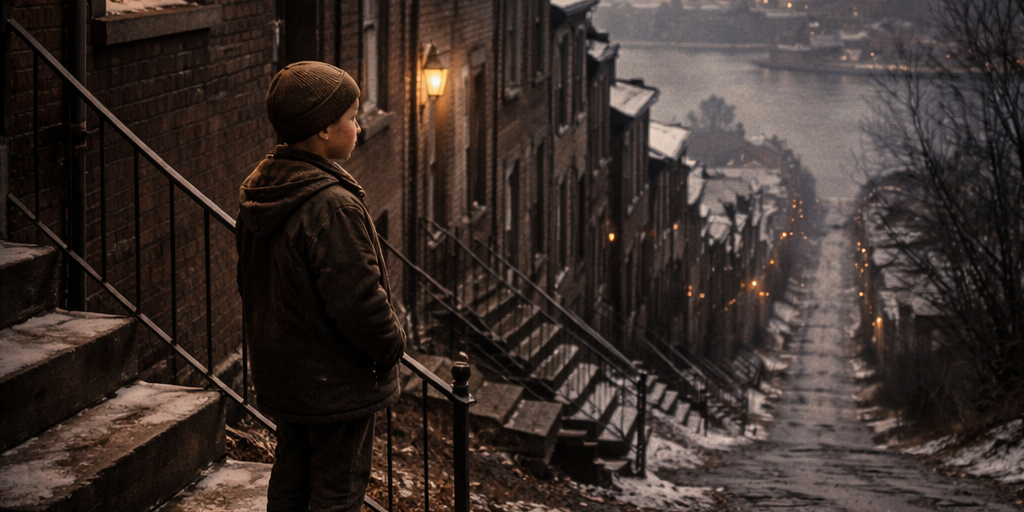
The family’s Pittsburgh addresses shifted over the years as circumstances allowed, moving through the Oakland and South Oakland areas. These were dense, immigrant neighborhoods where Eastern European languages mixed on the street, where the Byzantine Catholic church served as the center of community life, and where the expectation for most young men was a job in the mills or the mines, not a career in the arts.
Ondrej Warhola worked hard and expected his sons to do the same. He died in 1942, when Andrew was thirteen, from tuberculosis contracted during the years he worked in the mines. The loss fell hardest on Andrew, who was closest to his mother. Julia Warhola, a deeply religious woman with a gift for drawing and for the decorative arts she had brought from the old country, became the defining parent in the household that remained.
The Boy Who Collected Movie Stars
When Andrew was around eight years old, he contracted Sydenham’s chorea, a neurological condition sometimes called St. Vitus’ Dance that caused involuntary movements and left him bedridden for extended periods. The illness kept him home from school and isolated from the physical world of childhood. Julia, in an effort to keep her son occupied and content during his recovery, gave him coloring books, movie magazines, and eventually a camera.
The combination was formative in ways that would only become apparent decades later. Lying in bed with movie fan magazines, Andrew became fixated on celebrity: on the way stars were photographed, the way their images were reproduced and distributed, the machinery by which an ordinary human face became an icon. He began collecting autographed photographs from Hollywood studios, writing letters to request them and assembling the results into a personal archive of celebrity images. This was not a passing hobby. It was an early and intensive education in the relationship between image, reproduction, and fame.
The camera Julia gave him fed a related obsession. He photographed everything around him with a seriousness that was unusual in a child his age. By the time he recovered from his illness and returned to school, Andrew Warhola had spent years studying how images worked and what they meant. The Factory, the silk screens, the endless reproductions of Marilyn and Mao and Campbell’s soup cans, they all have a direct line back to a sick boy in a Pittsburgh bedroom reading movie magazines.
Free Saturdays at the Carnegie
Pittsburgh gave Warhol something else during those years that is easy to overlook: access to serious art instruction at no cost. The Carnegie Museum of Art, part of the Carnegie Institute complex in Oakland that Andrew Carnegie had built as a gift to the city, offered free Saturday art classes for children. Andrew attended regularly throughout his school years.
Oakland was already establishing itself as Pittsburgh’s center of culture and education, and the Carnegie’s children’s programs brought working-class kids from across the city into contact with serious art and serious instruction that their family budgets could never have otherwise afforded. For Andrew Warhola, the son of immigrants in a neighborhood where art was not a profession anyone seriously contemplated, those Saturday classes were a critical opening.
He was, by all accounts, a genuinely gifted student. His teachers recognized the talent early. He was quiet and observant and produced work with a facility that went beyond technical skill into something harder to teach. By the time he reached high school, art was not just something he liked. It was the thing he was clearly meant to do, even if the path from that recognition to any viable career was not obvious from where he was standing.
Carnegie Tech and the Education That Changed Everything
In 1945, Andrew Warhola enrolled in the Department of Pictorial Design at the Carnegie Institute of Technology, which is today Carnegie Mellon University. The school sat in Oakland, close to the museum where he had taken his Saturday classes as a boy. Getting in required talent. Staying in required something more.
The early going was difficult. After his first year, Warhol was informed that he might not be permitted to continue due to his academic standing in non-art courses. He spent part of that summer in New York, looking at the work being done there and absorbing the energy of the commercial art world. He returned to Carnegie Tech with renewed focus, passed the necessary evaluations, and continued.
The education he received there was rigorous and technically demanding. Carnegie Tech was not a casual art school. It trained students in the practical disciplines of commercial and graphic design with the expectation that they would go out and earn a living. Warhol learned layout, illustration, typography, and the principles of visual communication as professional skills, not as fine art abstraction. This training, which was fundamentally about how images communicate at scale and in commercial contexts, would become the engine of his entire mature career.
He graduated in 1949 with a Bachelor of Fine Arts in pictorial design. Within weeks he was on a bus to New York.
What Pittsburgh Put Into the Work
The temptation when writing about Warhol is to treat Pittsburgh as the place he escaped from and New York as the place where he became himself. That framing is too simple and probably backward.
The working-class immigrant Pittsburgh that shaped him was a world organized almost entirely around repetition and mass production. His father’s construction work, the mill shifts keeping the neighborhood running, the church calendar cycling through the same liturgical sequence year after year, the factory whistles marking time in regular intervals: Andrew Warhola grew up in a world where repetition was not monotony but structure, not emptiness but meaning. The repeated image, the silk screen run off a dozen or a hundred or a thousand times, is not so foreign to that world as it might seem.
The Byzantine Catholic faith of his family also marked him in ways that art historians have increasingly recognized. The visual tradition of the Byzantine church is built on the icon, the sacred image reproduced in consistent, formalized form, with the power of the image residing in its subject rather than in the individual artist’s hand. Warhol attended church faithfully throughout his adult life in New York, volunteering at a soup kitchen operated by his parish and keeping his religious practice largely private. The Factory’s relationship to the icon, the celebrity image as a kind of secular religious object, the star as saint, is not an accidental parallel.
The Andy Warhol Museum
Andy Warhol died on February 22, 1987, in New York, following complications from gallbladder surgery. He was fifty-eight years old. He is buried at St. John the Baptist Byzantine Catholic Cemetery in Bethel Park, Pennsylvania, a suburb south of Pittsburgh. His grave is a regular destination for visitors who make the trip specifically to leave flowers, soup cans, and other tokens at the headstone of the man who made both of those things famous.
In 1994, seven years after his death, the Andy Warhol Museum opened in Pittsburgh’s North Shore neighborhood. It is the largest museum in the United States dedicated to a single artist, housing the most comprehensive collection of Warhol’s work anywhere in the world along with extensive archival materials, film, and personal artifacts. The building itself is a converted warehouse, which feels appropriate.
The museum is not simply a tribute. It is a serious research institution, and its presence in Pittsburgh rather than New York carries a specific meaning. Warhol’s estate and the foundations that created the museum chose to put it here, in the city where he was born and formed, because Pittsburgh is where the story actually starts. New York is where it became famous. Pittsburgh is where it became possible.
Why the Pittsburgh Story Matters
Warhol spent the last four decades of his life constructing an image of himself as a creature of pure New York sophistication, and he was very good at it. The deliberate blankness, the silver wig that replaced his thinning hair, the monosyllabic deflections in interviews, the cultivated mysteriousness: all of it was a performance, and a brilliant one. But performances require a performer, and the performer was a kid from Pittsburgh who grew up in an immigrant household, attended Byzantine Catholic mass, drew pictures in bed during a childhood illness, and took the bus to Saturday art classes at the Carnegie because they were free.
The Pop Art movement that Warhol defined was, at its core, about taking the imagery of mass production and mass consumption seriously as aesthetic material. Soup cans. Brillo boxes. Repeated celebrity photographs. The stuff of factories and grocery stores and movie magazines elevated to the gallery wall. It is not a coincidence that this vision came from a man who spent his first twenty years in one of the great industrial cities of the twentieth century, surrounded by the products and rhythms and visual language of mass manufacturing.
Pittsburgh made a lot of things during the years Andy Warhola was growing up there. Steel. Glass. Aluminum. Radio signals. It also, in a way it did not fully recognize at the time, made one of the most influential artists of the twentieth century. He came back home in the end, to a cemetery in the suburbs south of the rivers. You can visit the grave. You can bring flowers, or a can of soup. Either is appropriate.