

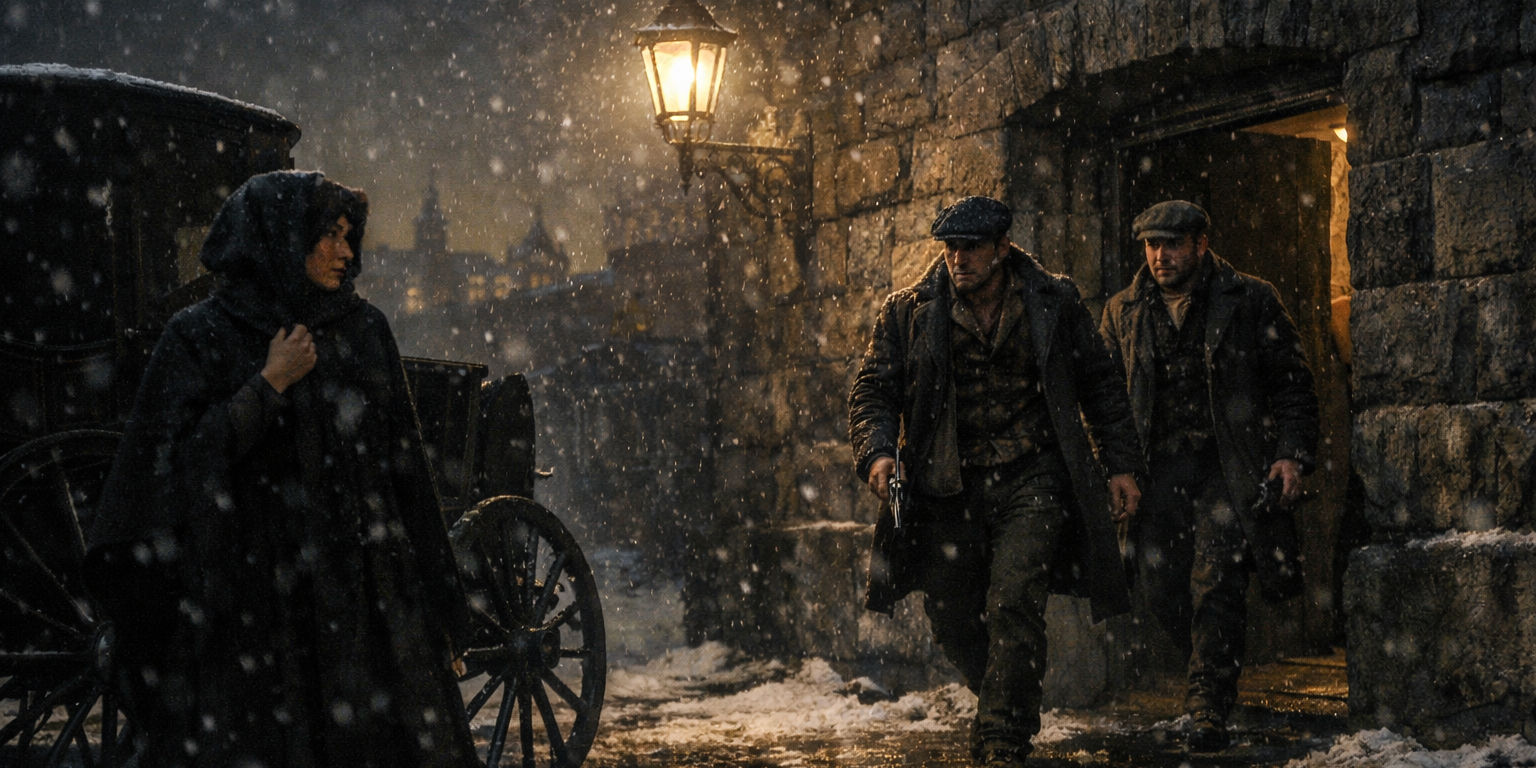
If you lived in Pittsburgh in January 1902, you couldn’t escape the story. Kate Soffel—wife of the Allegheny County Jail’s warden—helped the condemned Biddle Brothers escape and fled with them into the winter night. The scandal shocked Pittsburgh and became one of the most notorious crimes in the city’s history.
Who Was Kate Soffel?
Kate Soffel, born Anna Katharina Dietrich, was the wife of Warden Peter Soffel who ran the Allegheny County Jail. She was a mother, a proper Pittsburgh woman expected to host, volunteer, and keep the household steady while her husband ran one of the most intimidating buildings in the county. For a brief, blazing moment, she became the most notorious woman in Pittsburgh. She helped the condemned Biddle Brothers escape from prison. She fled with them into the January dark. She was captured in a storm of gunfire. One brother died. Then the other. And Kate Soffel, the respectable matron, was sent to prison while Pittsburgh tried to explain how this could have happened at all. More than eighty years later, Hollywood retold the scandal in the film Mrs. Soffel, starring Diane Keaton and Mel Gibson, cementing the story’s status as Pittsburgh’s first true celebrity crime romance. But the real story is stranger and sadder than any movie version.
The Biddle Brothers: Pittsburgh’s Most Notorious Outlaws
By 1901, the Biddle Brothers—Ed and Jack Biddle—were already famous, the kind of criminals who became folk villains in a city hungry for sensation. They were tied to robberies and assaults linked to the so-called “chloroform gang” style of attacks, and they were convicted of murder, awaiting execution. While they awaited the hangman, the Allegheny County Jail held them like a stone fist. The place was designed to crush time itself, to make days indistinguishable, to make men feel small. And then Kate Soffel entered the picture.
How Kate Soffel Met Ed Biddle
Kate visited prisoners as part of charitable or religious efforts, bringing Bibles and offering conversation meant to reform the soul. It was the kind of thing a warden’s wife might do in that era—half duty, half performance, half genuine compassion. The jail was her husband’s domain, but also her stage. Then she met Ed Biddle. If you want to understand how a woman like Kate Soffel ends up in a gun battle on a snowy road, you have to understand the psychological trap hidden in that kind of “charity.” A prisoner has nothing but time, and conversation becomes currency. A woman like Kate, living within strict social expectations, may have had very little space to be seen as a full person rather than a role. Ed Biddle, charming and desperate, had every incentive to look into her eyes and make her feel like the most important woman in the world. According to later accounts, Kate became infatuated with Ed. In some tellings, it was romance. In others, manipulation. But the result was the same: she crossed a line that respectable Pittsburgh women were not supposed to cross, and then she kept going.
The 1902 Allegheny County Jail Escape Plan
The details that matter are not the cinematic ones. They are the practical ones. A jailbreak is not a single decision. It is a chain of smaller decisions, each one easier than the last because you already crossed the previous line. Kate Soffel began supplying the Biddle Brothers with tools and weapons. Sources describe saws and firearms smuggled into the jail, concealed in ways that took advantage of the clothing and assumptions of the time. The brothers worked their bars. They planned the moment. And they waited for the hour when the jail was most vulnerable, when fatigue softened vigilance and routine turned into a lullaby.
The Night of the Biddle Brothers Escape: January 29, 1902
The escape took place on the night of January 29, 1902, spilling into the early hours of January 30. It happened in the deep dark of winter, when most of Pittsburgh was asleep and the city’s moral imagination was at its weakest. The method was brutal: One of the brothers lured a guard close by claiming illness. When the guard approached, Jack Biddle attacked. Another guard was shot in the chaos. Guards were overpowered, locked away, and the brothers moved through the jail with the urgency of men who knew the rope was coming for them. Then, unbelievably, Kate Soffel did not just help them escape. She went with them. That is the detail that transformed this from crime story into scandal legend. It is one thing for a warden’s wife to be tricked into smuggling a tool. It is another thing entirely for her to step out into the freezing night and choose exile with condemned men.
Pittsburgh’s Reaction to the Kate Soffel Scandal
Pittsburgh in 1902 was a city of reputations. You were your name. Your family. Your church. Your neighborhood. Your standing. So when Kate Soffel vanished with the Biddle Brothers, the story detonated. Imagine the outrage. The jokes. The sermons. The disgust. The thrill. For the men who read the papers over breakfast, it was proof women were dangerous when they stepped outside their assigned roles. For the women who read between lines, it was a terrifying cautionary tale and, for some, a secret fantasy of escape from a life of duty. And for the city itself, it was humiliation. Because the Allegheny County Jail was supposed to represent control, yet its warden’s own household had become the weak point.
The Flight North: Kate Soffel and the Biddle Brothers on the Run
After the escape, the fugitives moved quickly through the North Side corridor and then out toward the edges of the city. One of the most vivid details preserved in archival retellings is how ordinary their escape looked at first. They used a trolley heading toward West View. Think about that: three of the most hunted people in Western Pennsylvania riding public transportation in the dead of winter. Then they stole a horse and sleigh from a local farm once the trolley line ended, pushing farther north into the countryside. The goal was Canada. A clean border. A new life. A place where the story could not follow. But stories like this always follow.
The Gun Battle That Ended the Biddle Brothers Escape
The manhunt closed in. Accounts agree that the flight ended in a confrontation north of Pittsburgh that turned violent. The Butler Eagle recounts that the escape and pursuit culminated in a gun battle along what is now Old Route 422, with the Biddle Brothers and Kate Soffel wounded, and the brothers mortally so. This is where the romance story curdles into tragedy. Ed and Jack Biddle ultimately succumbed to their injuries, with February 1, 1902 commonly cited as the date of death. Kate Soffel survived. And surviving meant she had to face what she had done—not as a dramatic gesture of love, but as a crime committed against the public trust in a city that would never forgive her.
Kate Soffel’s Trial and Imprisonment
Once captured, Kate Soffel confessed to aiding the escape: she helped provide tools and assistance. She was prosecuted and sentenced to two years at Western Penitentiary, with release in December 1903 after a reduction. Her husband’s career did not survive the scandal. Peter Soffel was removed as warden and later divorced Kate. In a story full of public spectacle, this part is almost quietly devastating. Kate was not just punished by the courts. She was punished by the social world that had defined her identity in the first place. In 1902, a man could be disgraced and eventually rebuild. A woman could be disgraced and erased. After prison, Kate Soffel attempted to capitalize on notoriety in theatrical form, then faded into a quieter life. Her death in 1909 is commonly reported as the end of a life that never recovered its footing.
Was Kate Soffel Manipulated or in Love?
Every generation asks the same question: was she manipulated, or was she in love? The honest answer is that we cannot know with certainty. But we can say a few grounded things: First, Kate’s access mattered. Without her, the Biddle Brothers likely don’t get tools and weapons inside the jail. Second, Ed Biddle had every incentive to cultivate her. He was facing death. In that situation, persuasion is survival. Third, Kate’s decision to flee with them suggests something beyond a single moment of foolishness. It suggests commitment, desperation, and a willingness to destroy her old life rather than return to it. Maybe she believed she was escaping a loveless marriage and a suffocating role. Maybe she believed she was saving a man she thought could be redeemed. Maybe she was caught in a psychological storm of attention, flattery, and illusion. The scandal’s lasting power comes from the fact that it can hold all those interpretations at once.
Why Pittsburgh Never Forgot the Kate Soffel Story
The Biddle Brothers were criminals, but criminals were familiar. Pittsburgh had seen violence and vice before. What made this case explosive was the violation of class and gender boundaries. A warden’s wife was supposed to symbolize moral order. Her role was to stand beside authority and make it look righteous. When she defected, it made people question the strength of the institutions themselves. If a respectable woman could be pulled into the underworld, then maybe the boundary between respectable and criminal was thinner than anyone wanted to admit. That is why this case became a “crime of the century” type story. It was not just that two condemned men escaped—it was that Pittsburgh felt betrayed by its own image.
The Haunted Legacy of Allegheny County Jail
The old Allegheny County Jail has its own mythology in local storytelling, and Kate Soffel’s name is woven into that mythos—sometimes as history, sometimes as ghost story, sometimes as a moral fable. Even modern writeups of the jail’s haunted reputation still invoke her as part of the building’s lingering legend. Whether you believe in ghosts or not, the idea makes sense symbolically. If any place in Pittsburgh would hold emotional residue, it would be those stone corridors, where the city once locked away its fears and then watched those fears slip out through a hole cut by a woman who was supposed to represent safety.
The Mrs. Soffel Movie (1984): Hollywood Meets Pittsburgh History
In 1984, the story reached a new audience with the film Mrs. Soffel, directed by Gillian Armstrong and starring Diane Keaton as Kate and Mel Gibson as Ed Biddle. Some jail sequences were filmed at the old Allegheny County Jail and the Allegheny County Courthouse, giving the movie a genuine Pittsburgh texture even as it dramatized the emotional core. But like many true story films, it plays loosely with details and compresses timelines. The movie presents certain facts loosely and even shifts the escape timing, while the real events unfolded around January 29-30, 1902. That tension is part of why the story remains so compelling. The facts are dramatic enough, yet every retelling still feels tempted to exaggerate them. Because the real scandal is already almost unbelievable.
Frequently Asked Questions About Kate Soffel
Who was Kate Soffel? Kate Soffel (born Anna Katharina Dietrich) was the wife of Peter Soffel, warden of the Allegheny County Jail in Pittsburgh. In 1902, she helped condemned murderers Ed and Jack Biddle escape from the jail and fled with them. What happened to Kate Soffel after the escape? Kate Soffel was captured after a gun battle, sentenced to two years in Western Penitentiary, and released in December 1903. Her husband divorced her, and she died in 1909. Did Kate Soffel love Ed Biddle? The nature of their relationship remains debated. Some accounts suggest genuine infatuation, while others suggest manipulation. Kate’s decision to flee with the brothers suggests deep emotional investment, but the exact motivation remains unclear. Is there a movie about Kate Soffel? Yes. Mrs. Soffel (1984), starring Diane Keaton and Mel Gibson, tells the story. Some scenes were filmed at the actual Allegheny County Jail and Courthouse in Pittsburgh. What happened to the Biddle Brothers? Ed and Jack Biddle were mortally wounded in a gun battle with authorities north of Pittsburgh on Old Route 422. Both died from their injuries on February 1, 1902.
If you want the broader outlaws-first angle, read about The Biddle Boys: Pittsburgh’s Most Notorious Outlaws. For the building itself and the darker atmosphere, explore The Haunted History of the Old Allegheny Jail. For the Hollywood connection and Pittsburgh filming locations, check out Famous Movies Filmed in Pittsburgh with Exact Locations You Can Visit.
A lot of Pittsburgh crime history is men with guns, men with money, men with grudges. Kate Soffel is different. Her story forces you to look at the era’s rules for women and ask what happens when someone trapped inside those rules finds a door that looks like freedom. It forces you to look at the justice system and ask why a jail that could hold two condemned men could not guard against the influence of intimacy and access. And it forces you to admit something uncomfortable: that the most dangerous contraband is not a saw blade or a revolver. It is the belief that your life is over unless you do something impossible. Kate Soffel did something impossible. For a few winter days, she outran respectability, outran reason, outran the life she was supposed to live. Then reality caught up, as it always does. And Pittsburgh, shocked and fascinated, turned her into a cautionary tale it could repeat forever.