
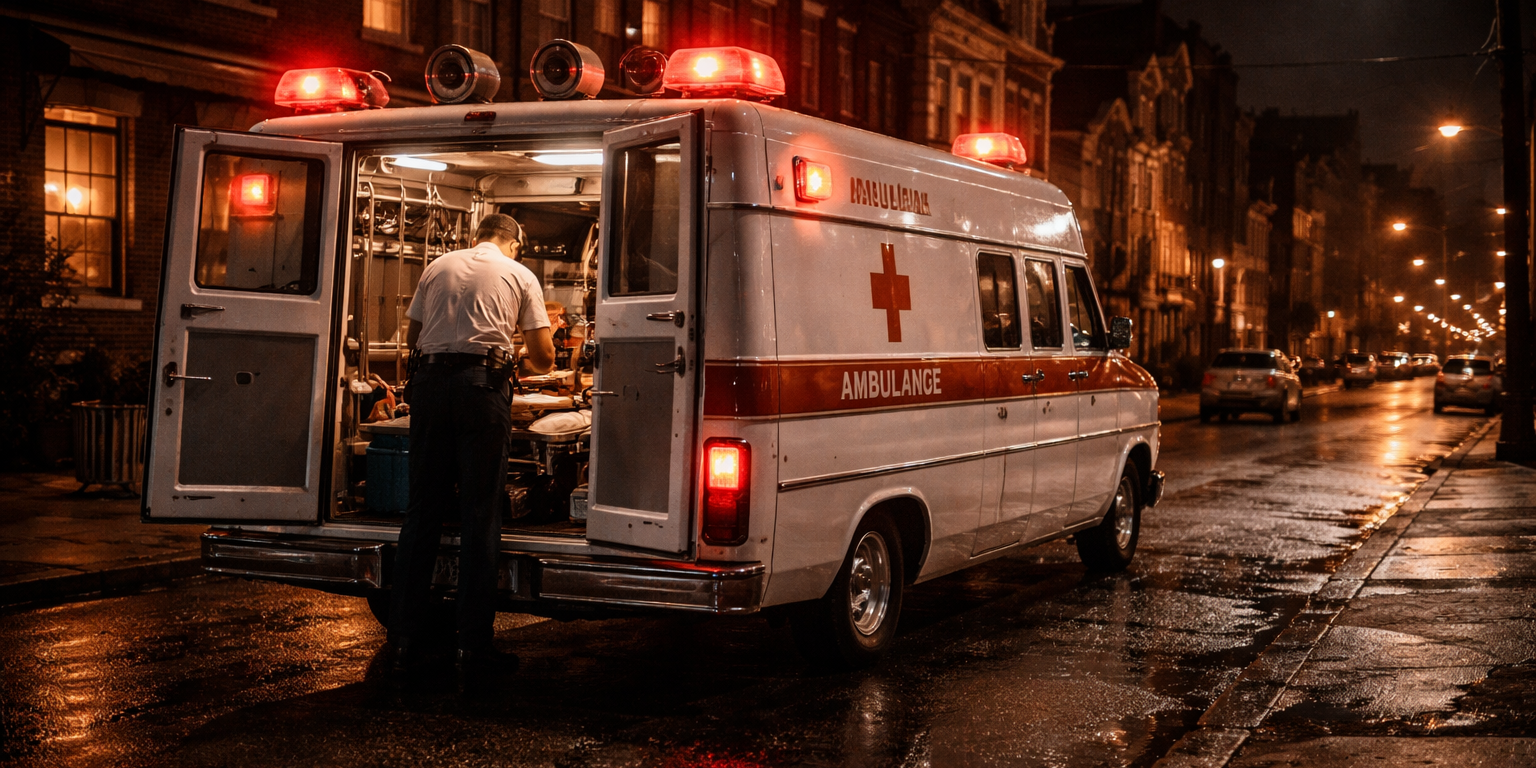
Somewhere in Pittsburgh’s Hill District in the late 1960s, a young man with no formal medical background beyond a rigorous training program was doing things in the back of a moving ambulance that had never been done outside a hospital. He was managing airways, starting intravenous lines, monitoring cardiac rhythms, and making clinical decisions that previously would have required a physician. He was saving lives that the previous system would have watched die. He was, without knowing the full historical weight of what he was doing, inventing the profession of paramedicine. Freedom House Ambulance Pittsburgh did not just provide emergency care to an underserved neighborhood. It created the template that every paramedic in America works from today, and almost nobody outside of Pittsburgh knows it happened.
This is a story about medical innovation, community necessity, and a profound injustice that followed a profound achievement. It belongs in the same conversation as any of the great Pittsburgh contributions to American life.
How Emergency Medicine Worked Before Freedom House
To understand what Freedom House changed, you have to understand what existed before it, which was very close to nothing. In most American cities in the 1960s, ambulance service was operated by funeral homes. The logic was grimly practical: funeral homes owned vehicles large enough to carry a body horizontally, and a body in medical distress was not categorically different from a body that had already passed in terms of the transportation requirements. The attendants who rode in those ambulances typically had minimal training, sometimes nothing beyond a basic first aid course. Their job was not to treat. Their job was to load and deliver.
For Pittsburgh’s Hill District, the situation was compounded by the racial dynamics of the era. Response times in Black neighborhoods were longer. The police, who sometimes responded to medical calls instead of ambulances, were not equipped or trained for medical emergencies. The practical reality for a person who collapsed from a heart attack or suffered a serious injury in the Hill District was that meaningful medical intervention would not begin until they reached a hospital emergency room, if they reached it at all. Every minute of transport was a minute of deterioration without treatment.
The mortality rates that resulted from this system were not mysterious. People died in ambulances and in the back seats of police cars from conditions that could have been treated in transit if anyone in the vehicle had known how to treat them. This was accepted as the normal cost of emergency medicine in the 1960s. It took a specific combination of a visionary physician, an existing community organization, and an underserved neighborhood in crisis to imagine a different answer.
Dr. Peter Safar and the Vision of Care in Transit
Peter Safar was an Austrian-born physician who had come to the University of Pittsburgh in 1961 to chair the anesthesiology department. He is best known to medical history as one of the key figures in the development of cardiopulmonary resuscitation: the combination of mouth-to-mouth breathing and chest compressions that has become the most widely taught emergency intervention in human history. CPR as a standardized technique owes a significant debt to Safar’s research and advocacy.
But Safar’s thinking extended beyond resuscitation techniques to the broader question of when and where emergency medicine could be effectively delivered. His central insight, which seems obvious now and was genuinely radical then, was that the period between the onset of a medical emergency and arrival at a hospital was not dead time that had to be passively endured. It was a window during which trained personnel could perform interventions that meaningfully changed outcomes. Airway management. Intravenous fluid administration. Cardiac monitoring and defibrillation. These were not beyond the capability of trained non-physicians. They required training, equipment, and the organizational will to make them available in the field.
What Safar needed was a population of trainees and a community in which to deploy them. The Hill District, and the organization already operating within it, provided both.
Freedom House Enterprises
Freedom House Enterprises was a community organization operating in Pittsburgh’s Hill District as part of the broader federal War on Poverty programs of the 1960s. Its mission was economic: to provide job training and employment opportunities for Hill District residents who were largely shut out of the mainstream Pittsburgh economy by discrimination, lack of credentials, and the structural disadvantages that accompanied both.
When Phil Hallen, president of the Maurice Falk Medical Fund, connected Dr. Safar’s medical ambitions with Freedom House’s workforce development mission, the combination was immediately logical. The Hill District needed better emergency medical services. Freedom House needed meaningful, skilled employment to offer its community. Safar needed trainees willing to learn a demanding new discipline. The program that emerged addressed all three needs simultaneously.
The men recruited for the program came from the Hill District. Many had limited formal education. Some had histories that would have disqualified them from conventional employment. What they had was the capacity to learn a demanding technical curriculum and the motivation that comes from being trained to help the community you actually live in. Safar and his colleagues designed a training program that was more rigorous than anything ambulance attendants had previously been asked to complete, and these men completed it.
What the Training Actually Involved
The Freedom House paramedic training was not a first aid course. It was an intensive medical education that covered advanced airway management including endotracheal intubation, intravenous catheter insertion and fluid therapy, cardiac rhythm interpretation using electrocardiogram equipment, electrical defibrillation for cardiac arrest, and a range of other interventions that had previously been the exclusive province of physicians and hospital-based nurses.
The rigor of the curriculum was a deliberate statement. Safar understood that the program would face skepticism, and not all of that skepticism would be medically grounded. Black men from a low-income Pittsburgh neighborhood claiming the ability to perform sophisticated medical procedures in the back of a moving vehicle were going to face doubt that had nothing to do with their actual competence. The answer to that doubt was a training standard so thorough that the outcomes would be undeniable.
The trainees proved the point. They mastered the curriculum. They passed the evaluations. They went into service, and they performed.
The Service in Action
Freedom House Ambulance began operating in 1968, serving the Hill District and surrounding neighborhoods with a level of care that nothing in Pittsburgh had previously offered. The crews responded to cardiac arrests, traumatic injuries, respiratory emergencies, and the full range of medical crises that urban emergency medicine encounters. They arrived with equipment and training that the funeral home ambulances could not match, and they used both.
The outcomes were measurable and striking. Studies conducted during the program’s operation found that Freedom House’s survival rates for cardiac arrest and other serious emergencies exceeded what comparable patients experienced elsewhere. The care being provided in the back of those ambulances was not merely better than the funeral home alternative. In documented cases it was producing results that compared favorably with hospital emergency departments.
Word spread through the Hill District community, which responded with the trust that good medicine earns. Freedom House became the ambulance service that people in the neighborhood actually wanted, not simply the one that arrived. For a community that had experienced generations of being underserved by civic institutions, this was not a small thing.
The Resistance They Faced
The program operated under pressure from several directions simultaneously. The established ambulance industry, operated primarily by funeral homes with economic interests in maintaining the existing system, was not enthusiastic about a competitor providing superior service. Some elements of Pittsburgh’s medical establishment were slow to acknowledge that non-physician personnel could perform advanced interventions effectively, a resistance that had both institutional and racial components that were difficult to fully separate.
City government was inconsistent in its support. The program relied on a combination of federal poverty funding and foundation grants that made its financial future perpetually uncertain. The equipment budget was chronically constrained. The crew members, who were performing work of genuine medical sophistication, were paid wages that reflected neither the difficulty of that work nor its value to the community they served.
Through all of it the crews showed up and did the job. The calls kept coming and Freedom House kept answering them, and with each year the evidence accumulated that what had been built in the Hill District was not an experiment or a novelty. It was a model.
1975: The City Takes the Model and Leaves the Workers
In 1975, the city of Pittsburgh decided to create a municipal emergency medical service. Pittsburgh EMS would take over the function that Freedom House had been performing and expand it citywide under city administration and funding. The decision was a direct acknowledgment that the Freedom House model had worked. Advanced life support delivered by trained non-physician responders was the future of emergency medicine, and Pittsburgh was going to embrace it.
What the city did not do was hire the people who had built that future.
When Pittsburgh EMS launched, the Freedom House paramedics, the men who had been trained by Peter Safar, who had refined the protocols through years of field experience, who had the deepest knowledge of the community they were serving, were not offered positions in the new service. The crews who had invented paramedic care in Pittsburgh were left without jobs as the city implemented a service modeled directly on their work.
This is the part of the Freedom House story that tends to produce silence when people first hear it. The silence is appropriate. It is difficult to characterize what happened in 1975 as anything other than a significant injustice layered on top of a significant achievement. The city essentially privatized the benefits of Freedom House’s innovation while declining to extend those benefits to the people who created it.
Freedom House Ambulance ceased operations in 1975. The men dispersed. The story largely disappeared from Pittsburgh’s public memory for decades.
The National Legacy They Left Behind
While Freedom House’s local story was being forgotten, its influence was spreading in ways that the crews themselves may not have fully tracked. The protocols and training standards developed by Safar and implemented by Freedom House became foundational documents in the national conversation about emergency medical services. The Department of Transportation, developing national EMS standards in the early 1970s, drew directly on the Freedom House model.
Every state that subsequently developed paramedic training programs was working from a template that Pittsburgh’s Hill District had field-tested. Every person who has ever been treated by a paramedic in the United States has benefited, in a direct if invisible way, from what was developed and proven on the streets of the Hill District between 1968 and 1975. The scale of that legacy is genuinely difficult to calculate.
The Recognition That Finally Came
For most of the decades following Freedom House’s closure, the program existed primarily in the memories of the men who had served in it and the community historians who understood its significance. Mainstream Pittsburgh largely moved on without fully accounting for what had been accomplished and then discarded.
That began to change as documentary filmmakers and medical historians started recovering the story. The Freedom House paramedics, some of them still alive, were finally able to tell their accounts to audiences who responded with the recognition the work deserved. The Hill District community that had produced Freedom House gradually reclaimed the achievement as part of its own complex and often underappreciated history of innovation under adversity.
Dr. Peter Safar, who died in 2003, is remembered in medical circles as one of the foundational figures of emergency medicine. His partnership with Freedom House, and the specific community context in which the modern paramedic was born, is increasingly central to how that history is told.
What It Means
Pittsburgh has a long list of things it contributed to the world: steel, aluminum, the radio broadcast, the Big Mac, pop art. The Freedom House Ambulance belongs on that list, and it belongs near the top. Every cardiac arrest victim who survives because a paramedic arrived with a defibrillator. Every trauma patient kept alive in transit by an airway intervention. Every person who made it to the emergency room because skilled hands were working on them before they got there. All of them are beneficiaries of what a group of young Black men from Pittsburgh’s Hill District learned to do in 1968.
They did not get the credit at the time. History is slowly correcting that. Pittsburgh should know this story, because it is one of the finest things this city has ever produced.