
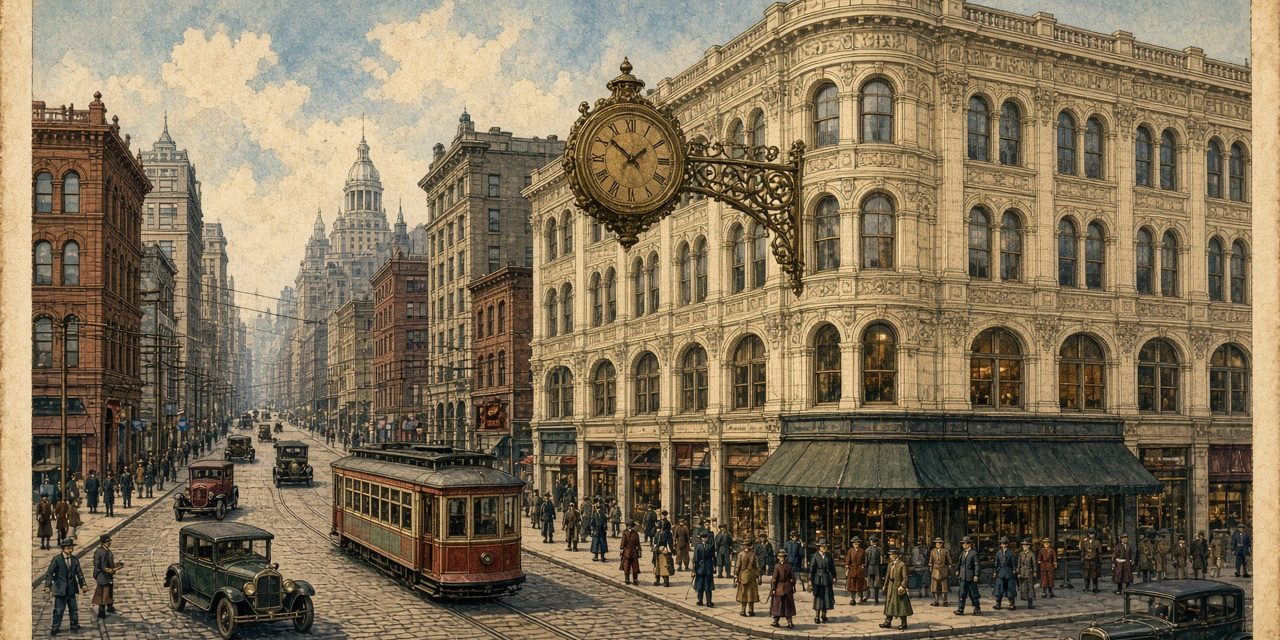
In 1991, a young Pittsburgh lawyer named Bill Lestitian called a woman he had never met and suggested they get lunch. Where, exactly? “Let’s meet under the clock at 12:30,” he said, meaning the Kaufmann’s clock downtown. She didn’t need an address. As she later told KDKA, it was “an easy landmark for me” (CBS Pittsburgh).
Nobody had to say which clock. For most of the twentieth century, the Kaufmann’s clock at Fifth Avenue and Smithfield Street was the one clock in Pittsburgh that needed no further description. Three years after that first lunch, Lestitian proposed to her in the same spot, on the sidewalk, in slush and snow.
The clock is still there. The store behind it is not, at least not as a store. How a tailor’s shop on Carson Street ended up with its own bronze landmark, and what happened to the building afterward, says a lot about how downtown Pittsburgh once worked.
Two brothers, a tailor shop, and $21,585
The Kaufmann’s story starts on the South Side, which in 1871 was still the borough of Birmingham. Two German-Jewish immigrant brothers, Jacob and Isaac Kaufmann, opened J. Kaufmann & Brother at 1916 Carson Street. They sold tailored and ready-made men’s clothing. According to the Heinz History Center and the University of Pittsburgh’s finding aid for the store’s records, they recorded $21,585 in sales their first year (Heinz History Center). They used some of that success to bring over two younger brothers, Morris and Henry, who joined in 1872 and 1876.
The family moved a few times. They shifted to 1932 Carson Street, then opened a second shop on Federal Street in Allegheny City on the North Side around 1875. By 1877 or 1878 they had closed both and moved downtown to 83 Smithfield Street, on a corner they advertised as “Kaufmann’s Cheapest Corner” (Rauh Jewish Archives). They kept buying the adjoining lots. By 1886, the Rauh Jewish Archives says, the business filled a whole block of Smithfield Street, and Pittsburghers called it “The Grand Depot” and “The Big Store.”
The Big Store kept adding things that made people want to walk in. The Heinz History Center lists a grand staircase and electric chandeliers in 1882 and a hydraulic elevator in 1885. By 1888 the shelves held women’s clothing, housewares, and shoes, which is when it started to look like a department store and not just a clothier.
The first clock, and a date nobody can agree on
Before the clock people remember, there was another one. It was a four-faced bronze clock on a post, standing on the sidewalk at the corner. When the store’s 1913 addition was finished, that clock came down, customers protested, and a new clock went up on the side of the building at the same corner, according to the Heinz History Center’s Google Arts & Culture exhibit text. The center also notes that “legend claims” a public outcry is why the clock exists at all, so treat the outcry as a story that has been told for a long time, not a documented event.
Disputed: When that first clock went up depends on who you ask. Pittsburgh Magazine says 1884. The Brookline Connection history site says 1887. Positively Pittsburgh says only “some time in the 1880s.” The Heinz History Center is not consistent with itself: its Google Arts & Culture text puts the freestanding clock in the 1880s, in connection with the “Grand Depot,” while its online store entry says the clock was added in the 1890s. I could not find a primary source, such as a contemporary newspaper item, that settles it, so the safest statement is that a post clock was standing at the corner by the 1890s and probably earlier.
The building has the same kind of fuzzy dating. The landmark marker at the corner credits architect Charles Bickel with the store in 1898, with an addition in 1913 by Janssen & Abbott (Historical Marker Database). Other accounts give 1887 for the original building, and the Heinz History Center describes Bickel as rebuilding a corner at Forbes Avenue in 1908. The likeliest explanation is that the Big Store was never one building but a block assembled in pieces over decades.
1913: the bronze clock goes up
The 1913 addition is the one that matters for the clock. That January the family incorporated the business as Kaufmann’s Department Store, and the Gazette Times called it “one of the most important department stores in the United States,” per the Heinz History Center. When the expanded building opened, the current clock was mounted on its corner, one story above the sidewalk instead of standing on a post below.
It is big. The Brookline Connection and Positively Pittsburgh both put the bronze clock at 2,500 pounds, and credit its design to the Coldwell Clock Company of New York. When a clockmaker restored it in 2020 and 2021, he removed one of the faces, which he said weighed 150 pounds, so that he could regild it (90.5 WESA).
Why the Kaufmann’s clock became the place to meet
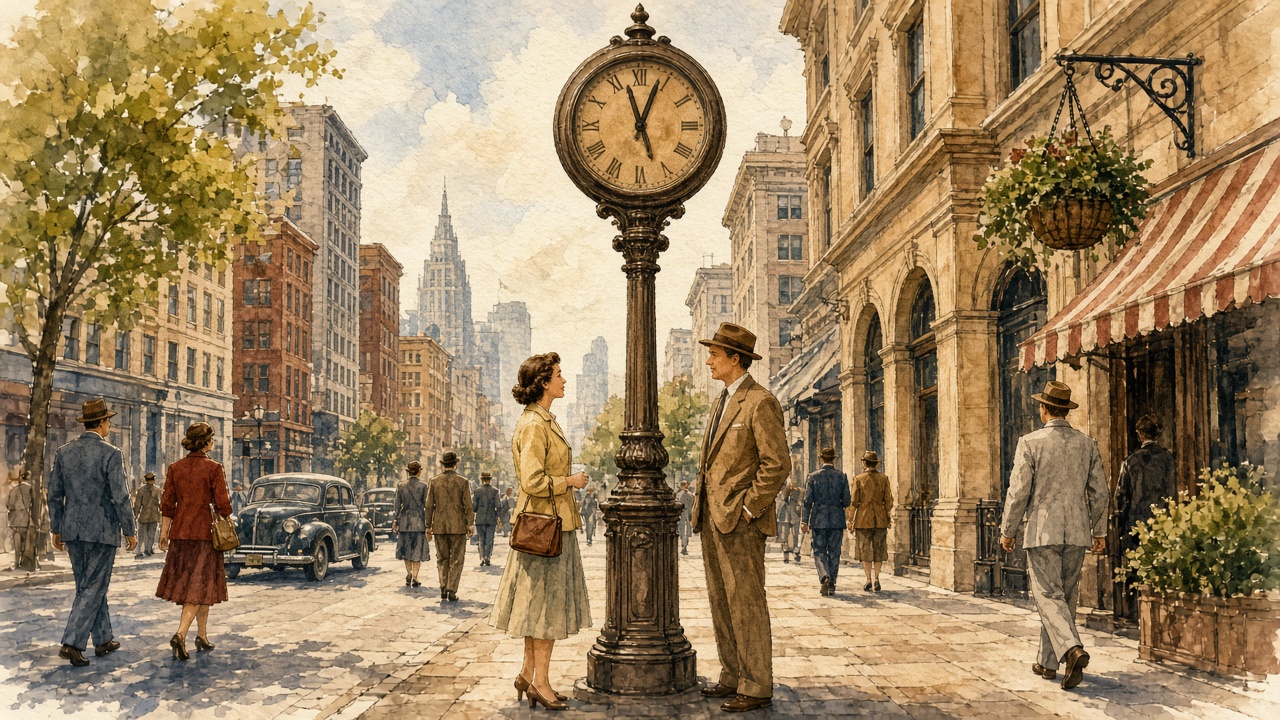
I could not find when “meet me under the clock” first appeared in print, and I would be wary of anyone who gives you a date. The Heinz History Center says only that “some accounts even suggest” the old post clock carried a sign reading “Meet Me Under the Clock,” and that the slogan kept showing up in Kaufmann’s advertisements for the next century. I could not confirm the sign. As for why the corner worked, here is my own reading, not a documented fact. It was a spot every downtown shopper already knew, it was visible from two streets, and it came with a public clock, so a vague “meet me around noon” turned into a precise plan.
The traditions around it are mostly affectionate folklore, and some are documented only as memories. On V-J Day in August 1945, Bette Sankey Sahar of Mt. Lebanon told 90.5 WESA in 2013, a man climbed up and sat on the clock while the crowd cheered him on. The memory is vivid, but it is one person’s recollection and I did not find a photograph of it. A less romantic use of the spot gets recorded too. Writer Vince Guerrieri notes in Belt Magazine that the clock was a meeting place for friends and, with a different sentiment, for enemies (Belt Magazine).
The Merchant Prince
The man most tied to Kaufmann’s golden age is Edgar J. Kaufmann (1885-1955), Morris’s son. He worked in the shipping department as a young man, had on his résumé stints at Marshall Field’s in Chicago, Galeries Lafayette in Paris, and Karstadt in Hamburg, and was named president of Kaufmann’s in 1920. The finding aid for the store’s photographs calls him the “Merchant Prince.”
Under Edgar, the store got a more polished reputation. In 1926 he staged an “International Exposition of Arts and Industries” with almost 100 foreign exhibits across the store. According to the same finding aid, on March 28, 1928, he placed what the collection describes as the first direct transatlantic telephone call from Pittsburgh to Paris. Other sources describe how Kaufmann’s tied the store to local research: the Carnegie Museum of Art says Edgar Kaufmann Sr. created a Commodity Standards Fellowship at the Mellon Institute to test merchandise, and the finding aid’s own description names Carnegie Institute of Technology instead, so I am not naming the institution here.
His taste is also why Pittsburgh has Fallingwater. Kaufmann commissioned Frank Lloyd Wright to design the family’s weekend house at Bear Run, and in 1937 construction began on a separate Wright design, a corner office on the tenth floor of the store, finished mostly in cypress with an abstract wooden mural, according to Fallingwater’s own timeline. Edgar Kaufmann Jr. gave the whole office to London’s Victoria and Albert Museum in 1974, where it is part of the museum’s collection (V&A). Our piece on Fallingwater covers the house itself.
Kaufmann’s money reached other parts of Pittsburgh too. He helped start the Civic Light Opera in 1946, and the story of how his plans and his philanthropy figured in the arena is part of our account of the Lower Hill demolition.
A lunch counter named for the clock
In 1946 the Kaufmann family sold the business to the May Department Stores Company, though Edgar stayed involved. On March 21, 1955, as part of a $10 million expansion, a new snack bar opened on the ground floor. The Heinz History Center says the expansion took the store from about 753,000 to about 1.16 million square feet, and the new restaurant was named the Tic Toc in tribute to the clock, whose image appeared on the menus and tables. It was open for breakfast and lunch, and it became one of the best-known lunch spots downtown, remembered for its burgers and desserts (Brookline Connection).
Edgar J. Kaufmann died on April 15, 1955, less than a month after it opened.
How downtown shopping slipped away
At its postwar peak, Belt Magazine notes, downtown Pittsburgh had five department stores, a lot for a city its size. Kaufmann’s was joined by Horne’s on Penn Avenue, Gimbels, Rosenbaum’s, and Frank & Seder. Then the customers started leaving. Frank & Seder closed its downtown store in 1958 and Rosenbaum’s in 1960, according to Belt. Kaufmann’s opened its first suburban branch in Monroeville in 1961, followed by Mt. Lebanon in 1964 and McKnight Road in 1965. Gimbels, which had come to Pittsburgh in 1925 by buying Kaufmann & Baer’s, a store founded by cousins of the Kaufmann brothers, closed its downtown store in 1986.
Pittsburgh tried to reverse it. Under Mayor Tom Murphy, city leaders lured Lazarus (1999) and Lord & Taylor (2000) downtown with tax breaks and incentives, and both closed in 2004, Belt reports. In Guerrieri’s words, downtown was “already on borrowed time” by the time Federated bought May in 2005. The Kaufmann’s name was retired in 2006, and the building operated as Macy’s for nine more years. Macy’s announced its closure in July 2015.
Macy’s, Inc. announced on July 13, 2015 that it was selling the building and closing the store, and the store closed for good on September 20, 2015, after a clearance sale, according to Macy’s and the Associated Press. (The Brookline Connection gives July 31, a date that matches neither event.)
What’s there now
The next years were rough. Core Realty bought the 13-story building in 2015 for $15 million, according to Pittsburgh Magazine, and redevelopment stalled amid delays and lawsuits. WESA described plywood over the windows where children once gaped at Christmas displays, and a famous clock that had stopped telling time.
In 2020 Lubert-Adler took over and put in $40 million. The building now holds 311 apartments, the 160-room Even Hotel, a parking garage, and ground-floor retail that includes a Target. Fastrack, the builder, told WESA there was not much left of old Kaufmann’s inside, only elevator doors, some old books, and a big brass K in the floor, so crews restored what they could and recreated the rest from photographs.
The clock got the most careful treatment. In 1987, according to Pittsburgh Magazine, it had been blasted clean with ground corncobs, using equipment normally used on bridges, at a cost of $30,000, and the Pittsburgh History & Landmarks Foundation had given both the building and the clock landmark status in 1981. In the recent restoration, clockmaker Roger Gordon of Titusville cleaned it, replaced the electric works and controller, which advance the minute hand with a pulse every 60 seconds, and regilded the faces.
It works. Walk down Smithfield Street today and you can still stop under it. The Macy’s years left their mark on the name, since the Brookline Connection notes that people grudgingly called it the “Macy’s Clock,” but the building is once again simply Kaufmann’s, as Pittsburgh Magazine put it. The one thing that hasn’t changed is the corner. If someone says they’ll meet you under the clock, you still know where to be.
Related reading on Steel City History: Fallingwater and The Pittsburgh Neighborhood Demolished to Build the Civic Arena.