
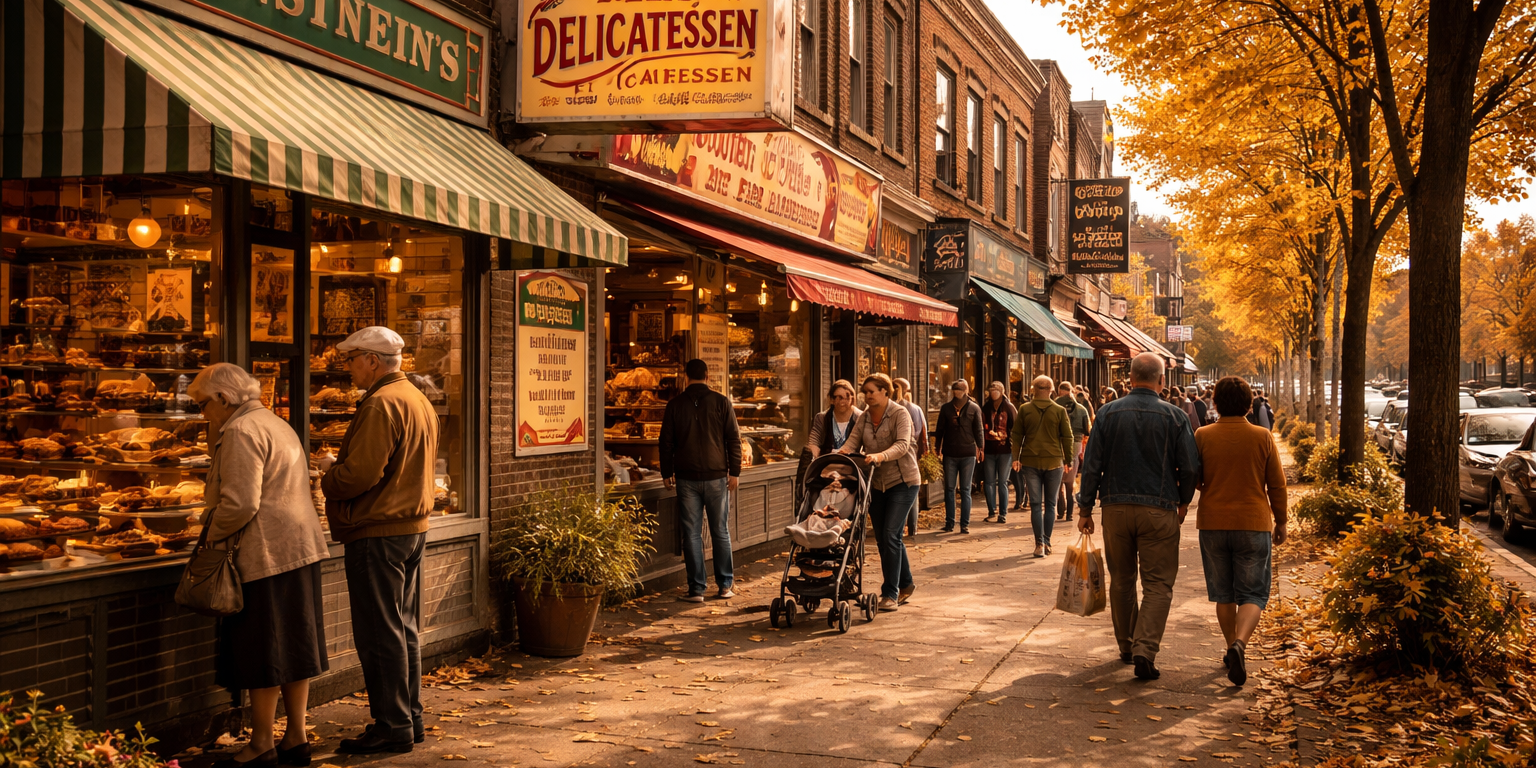
Squirrel Hill Pittsburgh sits on the eastern edge of the city where the land rises above Schenley Park and the great university campuses of Oakland, a neighborhood of tree-lined streets, brick rowhouses, and a commercial district on Murray Avenue that has been feeding and serving its residents for most of a century. It is one of the most cohesive urban neighborhoods in America, a place that has resisted the forces that hollowed out comparable neighborhoods in comparable cities across the country, and the story of how it became what it is and how it has endured what it has endured is one of the more remarkable stories in Pittsburgh’s history.
Squirrel Hill is the heart of Pittsburgh’s Jewish community, and has been for over a hundred years. It is also a neighborhood that belongs to everyone who has ever lived there or passed through it or grown up eating at its delis and walking its sidewalks, regardless of background. Understanding how a single neighborhood became the center of Jewish life in a mid-sized American industrial city, and how that community built something so durable that it is still recognizably itself in the third decade of the twenty-first century, is to understand something important about both Pittsburgh and about what urban communities are capable of when they commit to staying.
Before the Neighborhood
In the second half of the nineteenth century, the land that would become Squirrel Hill was largely undeveloped, a wooded hillside on the eastern edge of a city that was growing rapidly but had not yet pushed its residential development far beyond the river valleys and their immediate slopes. The extension of streetcar lines into the eastern neighborhoods in the late 1800s and early 1900s changed that. As reliable transit made it practical to live farther from the city center, the higher ground to the east became attractive for residential development, and developers began building the brick houses and apartment buildings that would define the neighborhood’s physical character.
The early Squirrel Hill that emerged from this development was a mixed neighborhood, middle-class and aspiring, with the Forbes and Murray Avenue corridors providing the commercial infrastructure that established neighborhoods require. It was accessible, relatively affordable compared to the more established affluent neighborhoods closer to downtown, and positioned on the streetcar lines that made daily commuting practical.
These qualities made it attractive to a specific population that was already in the process of moving through Pittsburgh’s residential geography in a pattern that Jewish immigrant families in American cities repeated across the country during the same period.
The Journey from the Hill District
Pittsburgh’s Jewish community had its earliest significant urban presence in the Hill District, the same neighborhood that was simultaneously developing as the center of Black Pittsburgh’s cultural and commercial life. Jewish immigrants arriving in Pittsburgh in the late nineteenth and early twentieth centuries settled in the Hill District and in adjacent downtown neighborhoods because that was where affordable housing and commercial opportunities for new arrivals were concentrated. They built synagogues, schools, and community institutions in the Hill District, and for a period the neighborhood contained a significant Jewish commercial and residential presence alongside its Black residents.
As families established themselves economically over one or two generations, the pattern common to immigrant communities in American cities repeated itself: upward mobility expressed as residential mobility. Families who could afford to move to more comfortable neighborhoods did so. The eastern neighborhoods, and Squirrel Hill in particular, became the destination. The institutions followed, or were rebuilt: synagogues moved or founded new congregations, community organizations relocated, the commercial infrastructure that served Jewish daily life established itself on Murray Avenue and Forbes Avenue.
The migration from the Hill District to Squirrel Hill was not instantaneous or uniform. It happened across decades, family by family, congregation by congregation. By the mid-twentieth century, Squirrel Hill had emerged as the established center of Jewish Pittsburgh in a way that seemed durable, and that durability has proven itself over the subsequent eighty years.
Building the Community
The institutional infrastructure that Squirrel Hill’s Jewish community built across the twentieth century is one of the more impressive examples of community self-organization in Pittsburgh’s history. Multiple synagogues representing the range of Jewish observance from Orthodox to Reform established themselves in the neighborhood, making it possible for families across the spectrum of Jewish religious practice to live in close proximity to houses of worship that matched their tradition.
The Jewish Community Center on Forbes Avenue became a civic and social hub serving not only Jewish residents but the broader neighborhood population through its programs, athletic facilities, and cultural events. Jewish day schools and supplementary Hebrew schools provided religious and cultural education. Community organizations addressed social welfare, Israel advocacy, and the range of institutional functions that a community’s internal life requires.
The commercial character of Murray Avenue reflected the community’s needs and preferences in ways that made the street immediately legible as a specific kind of place. Jewish delis and bakeries, kosher butchers, bookstores with Jewish literature and religious texts, the particular mixture of the sacred and the everyday that characterizes a densely Jewish commercial district: Murray Avenue had it all, and the combination created the experience of a neighborhood that was not merely a residential area but a community in the fullest sense of the word.
The Anomaly: Staying Urban
One of the most significant and underappreciated facts about Squirrel Hill is what it did not do in the postwar decades when most comparable American Jewish communities made a different choice. The great suburbanization of the American Jewish community that accelerated after World War II pulled Jewish families out of urban neighborhoods and into the new suburbs that were being built across the country. In city after city, the Jewish neighborhoods that had been built with the same care and density as Squirrel Hill emptied out. The synagogues closed or relocated. The delis shuttered. The community fabric that had taken generations to build dissolved into the dispersal of suburban development.
Squirrel Hill stayed. The reasons are multiple and not fully separable from each other. The neighborhood’s physical quality was high enough that it competed effectively with the suburbs for families who could afford to leave. The density of community institutions created a gravitational pull that was difficult to replace in a suburban development that lacked comparable infrastructure. The proximity to Carnegie Mellon University and the University of Pittsburgh provided an anchor population of faculty, students, and affiliated residents who valued urban living and helped maintain the neighborhood’s vitality.
The result is a neighborhood that looks, in many respects, more like its 1950s self than most comparable American urban neighborhoods. The same synagogues. The same deli culture on Murray Avenue. The same density of community institutions. The same mix of elderly longtime residents and young families who have chosen the neighborhood specifically because of what it offers. Squirrel Hill is not frozen in amber. It has changed in the ways that living communities must change. But its essential character has persisted in a way that is genuinely unusual in American urban history.
Fred Rogers and the Neighborhood
Fred Rogers lived in Squirrel Hill for much of his adult life. The neighborhood that he traveled through daily, the streets and the neighbors and the specific texture of community life that Squirrel Hill provided, informed in ways that are difficult to fully trace but impossible to ignore the vision of neighborhood he put on television every day for generations of children. The Neighborhood of Make-Believe was not a specific place, but its emotional foundation was the experience of living in a place where people knew each other, looked out for each other, and took seriously the responsibility of being neighbors.
Rogers was not Jewish, and his connection to Squirrel Hill was as a resident and neighbor rather than as a member of the community’s religious core. But his presence in the neighborhood and the neighborhood’s influence on his work is one of those Pittsburgh connections that the city has every reason to honor. The man who taught children what it meant to be a good neighbor learned it, in part, on Squirrel Hill’s streets.
October 27, 2018
No honest account of Squirrel Hill’s history can avoid what happened on the morning of October 27, 2018. A gunman entered the Tree of Life synagogue complex during Shabbat morning services and opened fire, killing eleven people and wounding others before being stopped. It was the deadliest antisemitic attack in the history of the United States.
The eleven people killed that morning were members of three congregations that shared the Tree of Life building. They were elderly members of a community that had spent lifetimes building and sustaining the institutions that made Squirrel Hill what it is. They were killed in a place of worship, on a Saturday morning, doing the most ordinary and sacred thing their tradition asked of them.
The attack stunned Pittsburgh and the country. It was an act of violence directed specifically at the Jewish community and specifically at the kind of rooted, multigenerational urban Jewish life that Squirrel Hill represented. The targeting was not incidental. The place chosen was the center of what had been built over a century.
The response from Pittsburgh was immediate and genuine. The phrase “Stronger Than Hate” emerged from the community and spread across the city and the country. Vigils drew thousands of people of every background. The outpouring of solidarity from neighbors, from the broader Pittsburgh community, from across the country, was both an acknowledgment of the horror of what had happened and an expression of the specific character of the community that had built Squirrel Hill over a hundred years. People showed up because they understood that what had been attacked was something real and valuable, something that belonged to everyone who had ever been part of this city.
The Tree of Life building itself has been at the center of ongoing conversations about how to honor the memory of the eleven who were killed and what the site should become. Plans for a memorial and museum have been developed through a process that has required the community to work through grief, disagreement, and the question of how to hold the past while allowing the future to move forward. The conversations are ongoing. The building still stands. The community is still there.
Murray Avenue Today
Walking Murray Avenue today is an experience of layered time. The delis and the bakeries that have been there for decades exist alongside newer restaurants and businesses that have arrived more recently. The synagogues are still in use. The JCC still anchors the Forbes Avenue corridor. Elderly residents who have lived in the neighborhood for fifty or sixty years share the sidewalks with graduate students from Carnegie Mellon and young families who chose Squirrel Hill specifically because of what it has always been.
The neighborhood’s stability is not the stability of stagnation. It is the stability of a community that has decided, generation after generation, that what exists here is worth maintaining, worth investing in, worth staying for. That decision has been made actively, not passively, by the families who chose not to move to the suburbs, by the institutions that chose to stay and reinvest, by the community organizations that continued to function even when comparable organizations elsewhere closed their doors.
Squirrel Hill is not perfect. Like any real neighborhood it has tensions and inequities and unresolved questions about who it belongs to and who it serves. But it has something that most American urban neighborhoods have not been able to maintain across a century of pressure: the quality of being genuinely itself, recognizably continuous with its own history, inhabited by people who know what it is and have chosen it for exactly that reason.
Why It Matters
Squirrel Hill matters to Pittsburgh’s history for the obvious reason that it is one of the city’s most significant neighborhoods, with a century of community life and cultural production behind it. It matters because it demonstrates that the forces that dismantled comparable urban communities in other American cities are not inevitable, that the right combination of community commitment and institutional investment can produce something durable.
It matters because of what happened on October 27, 2018, and because of what happened after: a community that had been attacked at its core responded not by dispersing but by gathering, not by retreating but by continuing. The eleven who were killed are part of Squirrel Hill’s history now, permanently. So is the response. Both of them say something true about what this neighborhood is and has always been.
Pittsburgh has produced many neighborhoods with distinctive characters and significant histories. Squirrel Hill is one of the most distinctive and one of the most significant, and its story is not finished.