
Isaly’s Pittsburgh: Chipped Ham, Klondike Bars & a Lost Legacy
Chipped ham Pittsburgh style is one of those foods that is almost impossible to explain to someone who did not grow up with it. Order it at a deli counter anywhere outside western Pennsylvania and watch what happens. The person behind the counter will look at you with genuine uncertainty. They may offer you regular sliced ham and suggest you are describing the same thing. They are not describing the same thing. Chipped ham, the paper-thin, almost feathery shavings of processed ham that pile into a soft cascade when properly prepared, is not a generic deli product. It is a specific Pittsburgh thing, and like most specific Pittsburgh things, it has a specific Pittsburgh origin. Isaly’s built the chipped ham Pittsburgh tradition, and in doing so created one of the most durable pieces of regional food identity in the country. It also, almost incidentally, invented the Klondike Bar. That second achievement is the one that conquered the world while the first one stayed home, and both deserve more attention than they typically receive.
The Family and the Dairy
The Isaly story begins with Swiss-German immigrants who brought with them both a tradition of dairy craftsmanship and an instinct for the retail food business. The Isaly Dairy Company took root in Ohio before spreading into western Pennsylvania, and it was in Pittsburgh and the surrounding region that the company found the population density, the working-class lunch culture, and the neighborhood commercial fabric that allowed it to grow into something genuinely beloved.
The model that Isaly’s developed was the dairy store: a clean, bright retail space that combined the functions of a neighborhood grocery’s dairy section, a deli counter, a lunch counter, and an ice cream parlor into a single destination. This was not a restaurant exactly, and not a grocery store exactly, and not an ice cream shop exactly. It was all three at once, and in an era before fast food chains had colonized every commercial corner in America, the Isaly’s store was the place you went for a quick lunch, an after-school treat, or the deli meats that went on the sandwiches you made at home.
At their peak, Isaly’s stores were woven into the commercial fabric of Pittsburgh’s neighborhoods in the way that truly successful local chains achieve: they became reference points. You didn’t give directions by streets alone; you gave them relative to the Isaly’s. The stores had a consistency of design and product that made each one feel like a specific outpost of a familiar place, which is exactly the psychological comfort that neighborhood retail at its best provides.
What Happened Inside
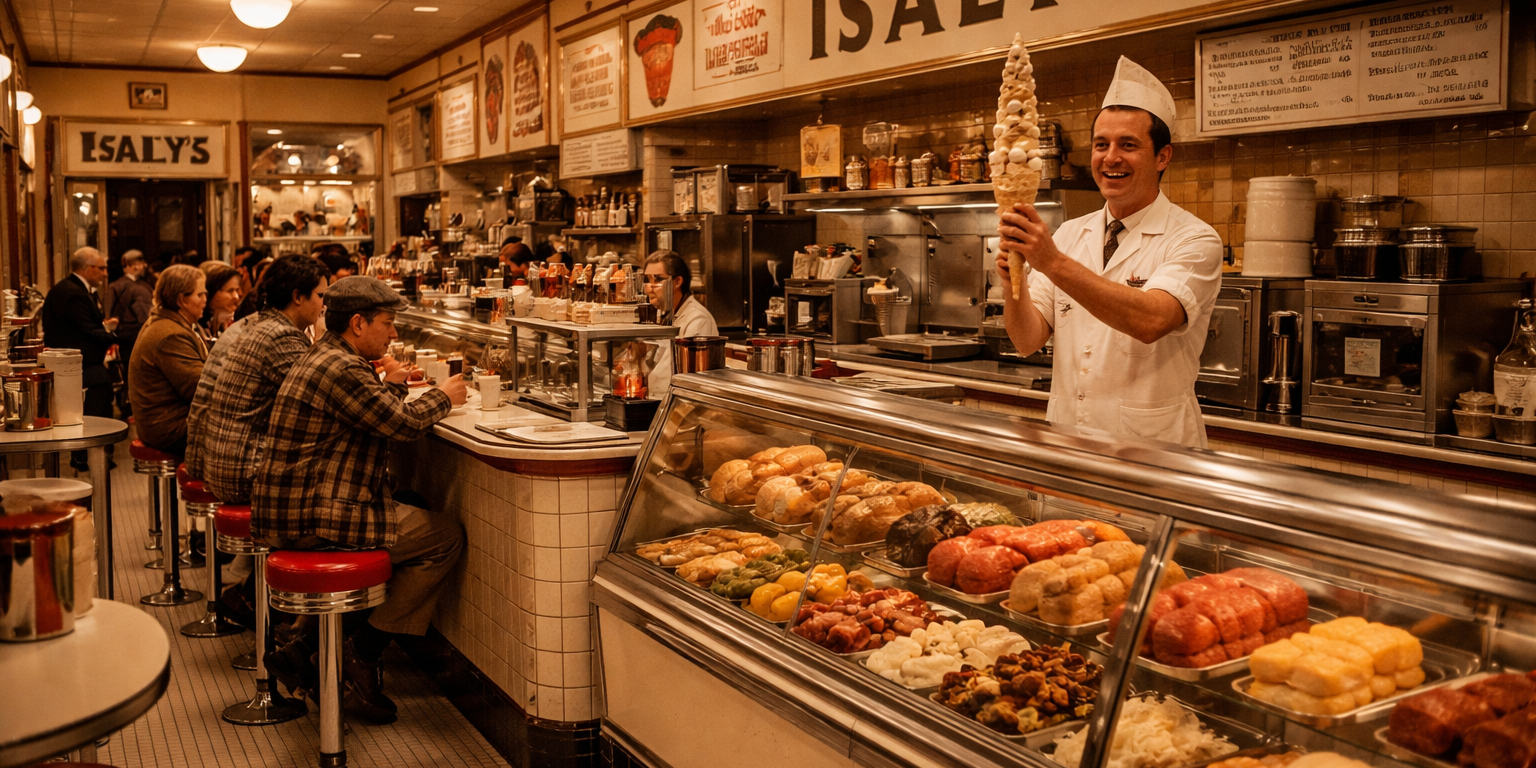
Walking into an Isaly’s store in its prime meant entering a space organized around the pleasures of dairy and deli. The cases held cheeses and deli meats and the dairy products that were the company’s founding business. The lunch counter offered sandwiches and simple hot food for the midday trade. And in the back or along one wall, the ice cream counter offered what became one of the most discussed features of the Isaly’s experience: the skyscraper cone.
The skyscraper was not soft-serve in the contemporary sense. It was a hand-built construction in which the counter person, using a specific technique developed and refined within the Isaly’s system, piled ice cream into a tower of improbable height on a standard cone. The skill required to build a proper skyscraper without the whole structure listing and collapsing was real and practiced, and Isaly’s counter workers were known for it. A well-executed skyscraper cone was an object of genuine local pride, and the fact that it required skill rather than machinery to produce gave it the quality of a small daily performance.
Pittsburgh children of multiple generations grew up with the skyscraper cone as a standard of ice cream excellence against which everything else was measured. The chain ice cream shops that arrived later offered consistency and convenience. They did not offer a counter person who could build you a tower.
Chipped Ham: A Pittsburgh Obsession Explained
The chipped ham that Isaly’s perfected and popularized is not complicated to describe but is surprisingly difficult to replicate. The ham is processed and pressed into a loaf, then sliced on a mechanical slicer at the thinnest possible setting, producing pieces so thin they are nearly translucent and curl and bunch into soft piles rather than lying flat. The texture is entirely different from regular sliced ham. The way it takes condiments, the way it sits on bread, the way it tastes in combination with a sweet barbecue sauce, which is the traditional Pittsburgh preparation, produces a sandwich experience that is genuinely distinct from anything else in the American deli canon.
Why Pittsburgh specifically developed this particular product and this particular devotion to it connects to the city’s industrial working-class culture. The chipped ham sandwich was cheap, filling, portable, and satisfying in the way that food prepared for people doing physical labor needs to be. A bag of chipped ham from the Isaly’s counter and a loaf of bread could feed a family for very little money. The sweet barbecue sauce preparation, homemade in most Pittsburgh households according to recipes passed between neighbors and relatives, added the kind of flavor complexity that made a simple sandwich feel like something more.
The tradition embedded itself into Pittsburgh food culture so completely that it survived the decline of Isaly’s itself. Giant Eagle and other Pittsburgh area grocery stores sell chipped ham at their deli counters today because the demand never went away. Pittsburghers who relocate to other cities include chipped ham on the list of things they genuinely cannot find anywhere else, alongside Primanti Brothers sandwiches and the wedding cookie table tradition. Food is one of the primary languages of regional identity, and chipped ham is one of Pittsburgh’s most fluent expressions.
The Klondike Bar: Pittsburgh’s Gift to the World’s Freezer
Of everything Isaly’s contributed to American food culture, the invention that traveled farthest is one that most Americans would not immediately associate with Pittsburgh. The Klondike Bar, the square of vanilla ice cream encased in a shell of chocolate, sold by the billions under the “What would you do for a Klondike Bar?” advertising slogan, was invented by Isaly’s.
The origin of the Klondike Bar within the Isaly’s operation places it in the early decades of the twentieth century, when the company was developing its product line alongside its store network. The concept was straightforward: take a portion of ice cream and coat it in chocolate to create a handheld treat that was more substantial and more shelf-stable than an unwrapped scoop. The square format was practical and distinctive. The chocolate shell provided both flavor and structural integrity. The result was immediately popular.
For decades the Klondike Bar was a regional product, known and loved in Pittsburgh and the surrounding area but not a national presence. It was one of those things, like chipped ham itself, that western Pennsylvania residents took for granted as a normal feature of the food landscape and were mildly surprised to discover did not exist in the same way elsewhere.
The trajectory changed when the Klondike brand was sold and eventually found its way into national distribution under new ownership. The “What would you do for a Klondike Bar?” advertising campaign, one of the more effective slogans in food marketing history, made the product a household name across the country and eventually internationally. Today Klondike Bars are manufactured by Unilever and sold worldwide. The Pittsburgh dairy company that invented them is largely absent from the story as it is told in national marketing and food history.
This is a pattern Pittsburgh knows well. The city has produced inventions and innovations that became enormous in the world without the city receiving full credit for producing them. KDKA invented commercial radio. Freedom House invented the modern paramedic. Isaly’s invented the Klondike Bar. In each case the thing left Pittsburgh and became something much larger than Pittsburgh, and the connection to its origin got thinner with each passing decade.
The Neighborhood Store as Community Institution
The Isaly’s stores occupied a specific social function in Pittsburgh’s neighborhoods that goes beyond the products they sold. In the working-class communities that surrounded Pittsburgh’s mills and factories, the neighborhood commercial strip was where daily life organized itself outside of the home and the workplace. The corner bar, the barbershop, the church, the corner store: these were the institutions that gave a neighborhood its texture and its continuity.
Isaly’s stores were part of that fabric. They were where kids stopped on the way home from school. They were where the counter person knew your name and your usual order. They were where the quality of the skyscraper cone you received was a mild but genuine expression of the relationship between the person behind the counter and the person holding it. This kind of commercial intimacy is not easily quantified and is not easily replaced, which is part of why its loss is felt so specifically.
The stores also served the function, common to neighborhood institutions in Pittsburgh’s heavily ethnic working-class communities, of being places where people from different backgrounds encountered each other on neutral commercial ground. The Polish Hill family and the Italian family from Bloomfield and the Black family from the Hill District all had Isaly’s stores in or near their neighborhoods, all serving the same chipped ham and skyscraper cones within the same familiar format. This sounds like a small thing. In cities as residentially segregated as Pittsburgh was through most of the twentieth century, shared commercial spaces were not a small thing.
The Decline
The forces that diminished Isaly’s are familiar to anyone who has watched American retail history unfold over the second half of the twentieth century. The supermarket, which concentrated grocery, dairy, and deli functions under a single large roof with lower prices made possible by volume purchasing, absorbed the everyday shopping trips that had previously been distributed across neighborhood specialty stores. The rise of fast food chains captured the quick lunch trade that Isaly’s counters had served. The shift of Pittsburgh’s population from dense urban neighborhoods to spread-out suburbs changed the commercial geography in ways that favored the car-oriented shopping center over the corner dairy store.
Isaly’s adapted imperfectly to these pressures. The store network contracted through the 1970s and into the 1980s, locations closing as leases ended or profitability declined beyond sustainability. The company went through ownership changes that further eroded the institutional identity that had made it distinctive. By the time the retail landscape of Pittsburgh had fully transformed, the Isaly’s store as a neighborhood institution had largely disappeared.
What did not disappear was the appetite for what Isaly’s had created. The chipped ham tradition persisted because Pittsburgh wanted it to persist. Grocery chains kept it on their deli menus because customers kept asking for it. The product outlived the company that invented it because it had become genuinely embedded in how Pittsburgh eats, which is the highest compliment any food can receive.
What Remains
The Isaly’s brand exists today in limited and intermittent form, with some products appearing periodically in regional markets. The stores are gone. The lunch counters are gone. The skyscraper cones are a memory that people who grew up with them describe with a specificity and warmth that speaks to how deeply the experience registered.
The Klondike Bar is in freezer cases worldwide, though its Pittsburgh origins are not prominently featured in its marketing. The next time you see one in a grocery store, the connection worth holding in mind is that the product in the wrapper traces back to a dairy company in western Pennsylvania that was trying to give its customers something good to eat. It succeeded more thoroughly than anyone involved could have imagined, and the success left Pittsburgh behind.
The chipped ham is still here. Ask for it at any Pittsburgh area deli counter and you will get exactly what you asked for, piled into that familiar cascade of paper-thin pink slices. Order it somewhere else and you will get the blank stare. The blank stare is, in its own way, a kind of tribute. It means Pittsburgh still has something nobody else has quite figured out how to replicate.