
In the entire history of professional sports, it is difficult to find a franchise whose story moves more dramatically from the edge of oblivion to the top of the world than the Pittsburgh Penguins. Pittsburgh Penguins history is not a straightforward rise-to-greatness narrative. It is something stranger and more interesting than that: a fifty-year chronicle of near-collapses, last-minute rescues, generational talents arriving at precisely the right moments, and a city that came within weeks of losing its hockey team multiple times before that team became one of the most decorated franchises in the sport. That any of it worked out the way it did borders on improbable.
The short version is five Stanley Cup championships. The full version starts in 1967, runs through bankruptcy and illness and tragedy, and involves one of the most remarkable second acts in American sports history.
The Expansion and the Beginning
For the first half-century of its existence, the National Hockey League operated with just six teams: the Montreal Canadiens, Toronto Maple Leafs, Boston Bruins, Detroit Red Wings, Chicago Blackhawks, and New York Rangers. The Original Six, as they came to be known, dominated a sport that was largely confined to the northeastern United States and Canada. In 1967, the league doubled in size overnight, adding six new franchises in a single expansion: the Philadelphia Flyers, Los Angeles Kings, Minnesota North Stars, St. Louis Blues, Oakland Seals, and the Pittsburgh Penguins.
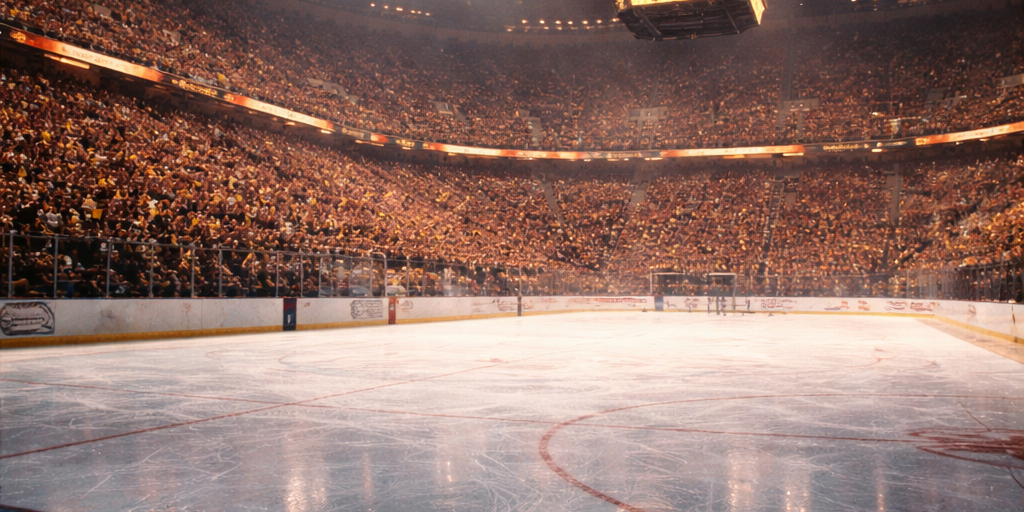
Pittsburgh’s inclusion made geographic sense. The city had a history with hockey, a large sports-minded population, and a venue. The Civic Arena, which had opened in 1961 on the lower slope of the Hill District, was one of the most architecturally unusual buildings in America: a domed structure with a retractable stainless steel roof, designed originally to house the Pittsburgh Civic Light Opera. The retractable roof never functioned reliably for hockey purposes, but the arena seated enough fans to make a franchise viable, and its distinctive silhouette, which earned it the immediate nickname the Igloo, became part of Pittsburgh’s skyline.
What the expansion did not provide was competitive balance. The new franchises were stocked through an expansion draft from the rosters of the established teams, which meant they received players those teams were willing to part with. The early Penguins were not good. This was expected. What was not entirely expected was how long the struggles would persist and how close the franchise would come to disappearing altogether before they ended.
Tragedy in the Early Years
The most painful chapter of the Penguins’ early history involves a player who never got to show what he might have become. Michel Brière was a young center from Quebec, drafted by Pittsburgh in 1969, who displayed in his rookie season a level of skill and instinct that made it clear he was something special. He was twenty years old, quick and creative, and the Penguins had genuine reason to believe they had found a cornerstone.
In May 1970, following the end of his first NHL season, Brière was involved in a serious car accident in Quebec that left him in a coma. He never recovered. He died in April 1971. He was twenty-one years old. The Penguins retired his number 21, and his memory has remained part of the franchise’s identity through all the decades since. Every young star the organization has developed exists in a tradition that includes, somewhere at its origin, a young man from Quebec who never got to finish his first full year in the league.
The Long Years of Struggle
Through the 1970s, the Penguins cycled through owners, coaches, and rosters with the frequency of a franchise that had not found its footing. Financial difficulties were chronic. The team was not competitive on the ice and was not profitable off it. In 1975, the situation became critical enough that relocation was a genuine possibility, with various ownership groups looking at moving the franchise to other markets entirely. Pittsburgh fans and city officials pushed back, emergency measures were taken, and the team stayed, but the franchise’s long-term viability remained genuinely uncertain.
The period reflects a broader truth about Pittsburgh in the 1970s. The steel industry that had built the city was contracting sharply, mills were closing, and the regional economy was under severe pressure. A struggling hockey team was, in some ways, a mirror of the city around it. Both were trying to figure out what came next.
What came next, for the Penguins, arrived in 1984 in the form of an eighteen-year-old from Montreal.
The Number One Pick
The 1984 NHL Entry Draft was not a normal draft. It was the draft that contained Mario Lemieux, and every team in the league understood that finishing last in the 1983-84 season meant winning the lottery for the most consequential player to enter the league in a generation. The Penguins, who had been bad for years, were bad enough that year to earn the first overall selection, and they used it without hesitation.
Mario Lemieux was six feet four inches tall, weighed two hundred ten pounds, skated with an effortless stride that made him look unhurried even at full speed, and had hands that allowed him to do things with a hockey puck that simply should not have been possible at that size. He won the Calder Trophy as the league’s best rookie in his first season. He won the scoring title multiple times. He was, by the assessment of virtually everyone who played with him, against him, or coached him, the most naturally gifted hockey player who had ever lived.
Lemieux did not immediately transform the Penguins into a contender. Building a championship team takes more than one player, regardless of how extraordinary that player is. But his presence changed the franchise’s trajectory in ways that went beyond the ice. People came to see Mario Lemieux. The Civic Arena filled. The organization had a foundation to build around, and through the late 1980s, general manager Craig Patrick systematically assembled the pieces that would eventually produce something remarkable.
Back to Back: 1991 and 1992
The Pittsburgh Penguins won their first Stanley Cup championship on May 25, 1991, defeating the Minnesota North Stars. The team that won it was built around Lemieux but was far from a one-man operation. Ron Francis, Paul Coffey, Jaromir Jagr, Tom Barrasso in goal, and a supporting cast assembled through drafts and trades had made Pittsburgh one of the most dangerous offensive teams in the league. The coach was Bob Johnson, an eternally optimistic figure whose signature phrase, “It’s a great day for hockey,” became a genuine expression of the joy he brought to the work.
The city had waited twenty-four years for a championship, and it responded accordingly. Pittsburgh, which had recently lived through the founding of what would become one of the NFL’s great dynasties, understood what a championship meant to a city’s identity. The celebration was enormous.
It was followed, almost immediately, by tragedy. That summer, Bob Johnson was diagnosed with brain cancer. He died in November 1991, four months after the championship he had worked his whole career to win. Scotty Bowman, one of the most accomplished coaches in hockey history, stepped in for the 1991-92 season and guided the Penguins to a second consecutive Stanley Cup championship. The team dedicated the second title to Johnson’s memory. It was one of the more emotionally complex championships in the sport’s history: a celebration of sustained excellence shadowed by grief for the man who had first made it possible.
Lemieux’s Illness and the Comeback
In January 1993, at the height of his powers, Mario Lemieux was diagnosed with Hodgkin’s lymphoma. He underwent radiation treatments and, in a sequence of events that became one of the most remarkable stories in sports history, returned to the ice in March 1993 and immediately resumed playing at an elite level, winning the scoring title that season despite having missed significant time for cancer treatment.
He managed his illness, continued to play at an extraordinary level through the mid-1990s, and retired in 1997. He was thirty-one years old and had spent nearly his entire career dealing with a succession of injuries and illness that would have ended most players’ careers years earlier. He was inducted into the Hockey Hall of Fame in 1997, his waiting period waived on account of his obvious qualification.
Three years later, he came back. In 2000, at the age of thirty-four, Mario Lemieux returned to the Penguins and played four more seasons at a level that reminded everyone why the arguments about the greatest player in history always come down to him and one or two others.
The Ownership Nobody Saw Coming
In 1999, the Pittsburgh Penguins declared bankruptcy for the second time in franchise history. The financial instability that had plagued the organization since its founding had never been fully resolved, and the bills had come due. The franchise appeared, once again, to be in genuine danger of folding or relocating.
What happened instead was unprecedented. Mario Lemieux was owed a significant sum in deferred salary from the franchise, money that had been promised to him and never paid. In the bankruptcy proceedings, he converted that deferred salary into an ownership stake in the team. The greatest player in Penguins history became the owner of the Pittsburgh Penguins.
It was an arrangement that had no real precedent in professional sports, and it worked. Lemieux, along with business partner Ron Burkle, stabilized the franchise financially, kept it in Pittsburgh, and created the organizational structure that would produce the next dynasty.
Sidney Crosby and the Second Dynasty
The 2004-05 NHL season was cancelled entirely due to a labor dispute between the league and the players’ association. The cancellation was painful for the sport, but it produced one significant consequence: the 2005 draft, the first draft after the lost season, would decide who received the rights to Sidney Crosby, an eighteen-year-old from Cole Harbour, Nova Scotia, who was already being compared to Wayne Gretzky before he had played a single professional game.
The Penguins won the draft lottery. Whether by luck or by the accumulated karma of all those difficult decades, Pittsburgh got Sidney Crosby, and the next chapter began.
Crosby became team captain at nineteen. He won the scoring title, the Hart Trophy as league MVP, and the respect of every player in the league in a remarkably short time. He was not Lemieux: he was shorter, stockier, more physically combative, less visually spectacular. But he was just as effective, and he was surrounded by talent that Lemieux, for most of his career, had not enjoyed. Evgeni Malkin, drafted the year before Crosby, was a force of his own, capable of carrying a team by himself on any given night.
The Penguins won the Stanley Cup in 2009, 2016, and 2017. The back-to-back championships in 2016 and 2017 made the Crosby-era Penguins the first team to win consecutive Cups since the Detroit Red Wings of 1997 and 1998, and cemented their status as one of the great dynasties of the modern NHL era.
Five Stanley Cup championships in total. Two distinct dynasties built around two players who arrived at precisely the moments the franchise needed them most, both of them selected with the first overall pick in their respective drafts, both of them the best players in the world at their peak.
The Improbable Arc
The full sweep of Pittsburgh Penguins history is not really a sports story, or not only a sports story. It is a story about a city and a franchise that kept finding reasons not to give up on each other. Pittsburgh nearly lost the Penguins more than once, and each time the franchise survived by the narrowest of margins before the next chapter began. The city that had watched its steel mills close and its population shrink held onto its hockey team through financial crises, ownership changes, and decades of losing, and was eventually rewarded with something that almost nobody could have predicted from the beginning: one of the most decorated franchises in the history of the sport.
It is still here. The games are still played. The Stanley Cup banners still hang in the arena. That none of it was inevitable is precisely what makes all of it worth remembering.