
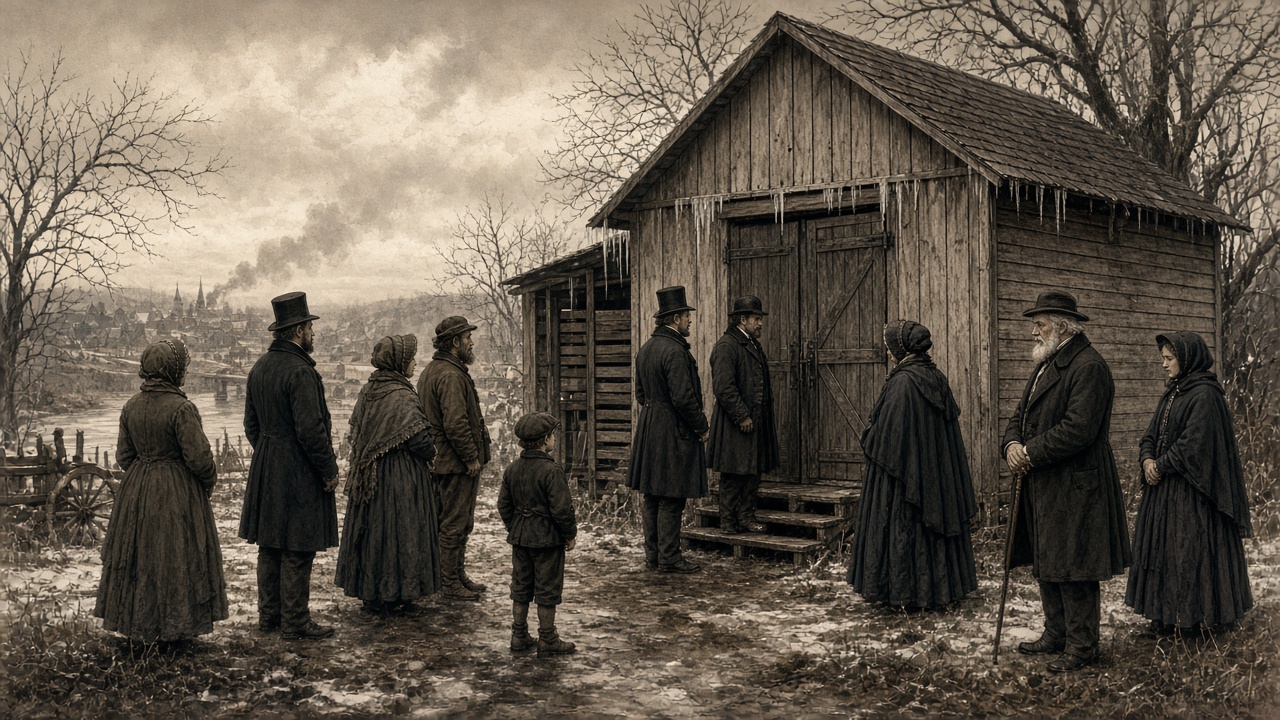
On Sunday morning, November 8, 1857, a fifteen-year-old named W. C. Smith noticed that the door of K. L. Blood’s icehouse in Brookville, Pennsylvania, had been broken open. He looked inside. On a block of ice lay a human body with its skin removed from the crown of the head to the soles of the feet. Smith ran into the street and told everyone he met. Within hours, hundreds of people had gathered around the icehouse, and the town took it for a murder. It was actually a case of Pennsylvania body snatching, and it is one of the best-documented in the western part of the state, because one of the men who took part later wrote down what happened and published it.
First, an honest note about the Pittsburgh angle. I looked for a documented grave-robbing case tied to a Pittsburgh medical school and did not find one in the sources I could check. That does not prove none existed. It means I can’t document one. The case below happened roughly eighty miles northeast of Pittsburgh in Jefferson County, and it matters here because it led to the state law that supplied Pittsburgh’s medical school with bodies a generation later.
Who was Henry Southerland?
The dead man was Henry Southerland, and the details of his life are worth stating before the gruesome part of the story. According to Dr. William J. McKnight’s 1917 history of Jefferson County, Southerland was the son of Charles and Susan Southerland. McKnight writes that his father had come to the county in 1812 as a runaway slave. Henry was born on a farm in the North Fork area, “a stout, perfect specimen of physical manhood” in McKnight’s words. He was living on the Charles Horn farm when he took a fever in late October 1857, and he died within days at about age thirty. He was buried in Brookville’s old graveyard.
That description matters for what followed. According to McKnight, the doctors chose Southerland because he was young and healthy. He was also Black, and historians who study the trade, including the Mütter Museum and the University of Pennsylvania’s West Philadelphia Collaborative History, say the burden of grave robbing fell heavily on poor and Black communities. Philadelphia’s 1882 Lebanon Cemetery scandal, which involved a Black cemetery, is the best-known example.
The night the doctors dug him up
McKnight was a young Brookville physician and a printer, and in his own telling he was one of the men who dug up the body. He published his account in the Brookville newspaper the Jeffersonian, billed as “The Truth Told by the Only One Now Living of Those That Were Engaged in It,” and reprinted it in his 1917 county history, Jefferson County, Pennsylvania: Her Pioneers and People. What follows is his version. Other people’s versions differ in places, as noted below.
He says another young doctor, J. G. Simons, wanted to become a surgeon and saw Southerland as a good “subject.” On the day Southerland died, Simons visited the other doctors in town and called a meeting for ten o’clock on Saturday night, October 31, in Blood’s drug store. About eleven that night, McKnight writes, seven men marched up Pickering Street with a mattock, a shovel, and a rope. McKnight and Dr. John Dowling stood watch. Blood, whose drug store they had met in, did much of the digging and broke open the coffin. They carried the body to an empty house that McKnight had arranged to borrow from another doctor, A. M. Clarke.
The plan fell apart almost immediately. McKnight writes that his mother told him on November 2 that word was already getting around, passed from one of the doctors through a chain of neighbors. The men moved the body to a hiding place under the front steps of the borrowed house, and then to Blood’s icehouse on November 4. Because so many people knew, McKnight says, they decided they could not dissect the body in Brookville. They skinned it instead “to prevent identification and for our personal safety,” and tried to ship it out of town. Dr. David Ralston was to come from Reynoldsville with a wagon on the night of November 7. But the key to the icehouse was lost, the door had to be broken open, and by the time it was, the wagon had driven off without the body. By McKnight’s account, the box the wagon carried was pushed into the creek at the North Fork bridge. The body stayed in the icehouse until Smith found it the next morning.
The inquest, and the wrong men
The town reacted with horror. A coroner’s inquest was held that evening, and the jury’s record, which McKnight prints in full, describes a male body “with the breast sawed open, the bowels and entrails removed, the toe and finger nails cut off at the first joint, and the skin of the entire body removed.” Henry R. Fullerton recognized some curly hair near the body and named Southerland. A crowd went to the grave with tools and found the coffin empty, with the burial clothes in a heap and one slipper lying in the clay above it. The jury’s verdict was that the body was Southerland’s, stolen from his grave, with the skin, bowels, and nails removed “by some person or persons to the jury unknown.”
McKnight writes that a rumor spread that a Black man’s hide was worth five hundred dollars to make razor straps. That is a rumor, one of the theories going around that day, and he records it as such. The Brookville newspaper, the Jeffersonian, called the act “one of the most inhuman and barbarous acts ever committed in a civilized community.” It later suggested a different explanation, that a thief had broken into the icehouse looking for butter stored there and run away when he found the body.
Meanwhile, the town needed someone to blame. McKnight writes that Southerland’s sister, Theresa Sweeney, was sent for on Sunday evening and filed an information against two Black men from the edge of town, Charles Anderson and John Lewis. A constable arrested them and put them in jail. At a hearing on Monday morning, with no lawyer and no friends to speak for them, they were discharged because there was no evidence against them. McKnight called them “innocent and inoffensive,” and wrote that “it was customary then to blame all obscure crimes” on Black men. The men who actually did it, he adds, benefited from the confusion, “as it gave time for the angry populace to cool off.”
What happened to the doctors
McKnight went into hiding the night of the discovery, and Blood left on business in Pittsburgh. By McKnight’s account, the lawyer and former Congressman David Barclay took charge of the prosecution, in part because of a political feud with Blood. McKnight returned on Tuesday night. His own brother, the attorney Amor A. McKnight, filed the information against him before a justice of the peace. McKnight pleaded guilty and was fined $25 plus costs, which he says made him “the only one who had to pay a penalty.” He explains that the guilty plea was meant to protect him from being tried again for the same offense. That is his own strategy and his own explanation.
It did not end there. In February 1859 a Jefferson County grand jury considered an indictment of McKnight and Blood for removing a dead body from a burial ground, with a long list of witnesses. McKnight reproduces the record, which ends with the words “Not a true bill. County to pay costs.” He says the witnesses who knew the facts refused to testify on the ground that they might incriminate themselves, and that the court sustained them. Blood and another of the doctors, Heichhold, ran in opposite political circles, McKnight adds, and for the rest of their lives, “whenever either one addressed a political assembly some wag or opponent in ambush would always interrogate the speaker” with a taunt about who had skinned Southerland. (The taunt used a racial slur, which McKnight prints and which I won’t.)
Pennsylvania body snatching and the law
Why would doctors do this? Pennsylvania in the 1850s had no real legal supply of bodies for anatomy teaching, and it was not for lack of demand. McKnight remembered dissection itself as a crime in Pennsylvania. Historian Venetia Guerrasio, in her 2007 study of the state’s anatomy law, says dissection was never illegal in the United States. The problem was an insufficient legal source of cadavers, which pushed doctors toward the graveyard, and that part was a crime. The first Pennsylvania law to address it was a local one in 1867, called the Armstrong Act, which covered only Philadelphia and Allegheny County. It allowed public officers to hand over the bodies of people who were to be buried at public expense to medical schools in proportion to their number of students, and it made trafficking in bodies a misdemeanor, per the text McKnight prints. Guerrasio calls it the “weaker predecessor” of the 1883 act.
The turning point came in December 1882, when the superintendent of Philadelphia’s Lebanon Cemetery and three accomplices were caught digging up a body. Dr. William S. Forbes of Jefferson Medical College was charged with conspiracy and acquitted in March 1883. McKnight, by then a state senator, writes that he was invited to dinner in Philadelphia around December 10, 1882, with Professor W. H. Pancoast of Jefferson, and that he proposed using the public outrage to pass a law. He writes: “I firmly believe that had I not been connected with and prosecuted in the pioneer resurrection case in Brookville, I would not have been impelled to propose such a law or to champion it in the Senate.” That is McKnight’s own account of his role. A 2016 article in the Journal of the History of Medicine and Allied Sciences by James R. G. Wright argues that McKnight deserves as much credit for the law as Forbes, who is usually called its father.
The result was the Anatomy Act of 1883, signed in June of that year. It created a state board that received the bodies of people who died at public expense, unless a relative or friend claimed the body for burial within a short window, and distributed them to medical schools, with penalties for neglecting the duty and for trafficking in bodies. Guerrasio’s study says the law became a model for other states, and that it effectively moved body procurement out of the graveyard and into official paperwork. She also argues that the law targeted powerless groups, and that legalizing the practice did not end its inequality.
Where Pittsburgh comes in
Pittsburgh got its statewide legal supply from that law (the 1867 Armstrong Act had already covered Allegheny County locally), and it was part of the machinery from the start. Guerrasio writes that the board hired undertakers as carriers, and the most important ones were in Philadelphia and Pittsburgh. In Pittsburgh, it was an undertaker named John Freyvogel, who eventually became the board’s trusted representative in Allegheny County. In 1923 the board’s secretary asked him to use his political influence with Allegheny County legislators against a bill the board opposed.
Pittsburgh’s own medical school came along after the law. The Western Pennsylvania Medical College opened in September 1886, according to the lost-colleges history of the school and a Pitt Med history of the early school, and its new building had a dissection room. It became the medical department of Western University of Pennsylvania in 1892, and when that university was renamed the University of Pittsburgh in 1908, the medical school was fully integrated into it. (One school-history site says the university bought it outright that year.) The story of how Oakland later became the city’s medical center is told in our article on Oakland.
Fact, rumor, and retelling
The documented parts of this story are strong. The coroner’s inquest, the 1859 indictment record, and the fine all appear in McKnight’s own book, and the broad outline appears in modern accounts. But the details of the night itself come mostly from one man, writing decades later (his text refers to the year 1898), who was a participant with reasons to shape the story. Some modern retellings differ. One local-history page says the body was taken to McKnight’s mother’s house and that she ordered it removed, but McKnight’s own account says she only warned him that the town knew. The rumor about razor straps, and the butter-thief theory, are rumors that people believed at the time, not findings of fact. And Southerland’s exact burial date varies from source to source.
Whatever else is uncertain, it is clear who paid. Henry Southerland was a young man who died of a fever and was buried by people who knew him, and his body was taken, mutilated, and left in an icehouse. For a day, the town jailed two innocent Black men over it, until a hearing found no evidence against them. The doctor who was fined $25 went on to help write the law that ended the practice, and that law, in turn, sent the next generation of unclaimed bodies to Philadelphia and Pittsburgh.
Related reading on Steel City History: Haunted Allegheny Cemetery and How Oakland Became Pittsburgh’s Education & Medical Hub.